Can your leaders walk into any situation as managers and handle them with ease? Do you think that your supervisors are at the top of their management game? Check out our infographic below to see if they have mastered the conversations that are on the top of our necessary list! (And don’t worry, if you think your supervisors and managers have room for improvement, we would love to help! Check out our full list of programs here).
Performance conversations are the regular, planned conversations in which a manager and an employee agree what good performance looks like, solve problems, review how the work is going and plan what comes next. They include the formal review but happen far more often than it does: in one-on-ones, project check-ins and the moments after something goes well or badly. Gallup attributes about 70% of the variance in team engagement to the manager [1], and these conversations are where much of that influence is exercised.
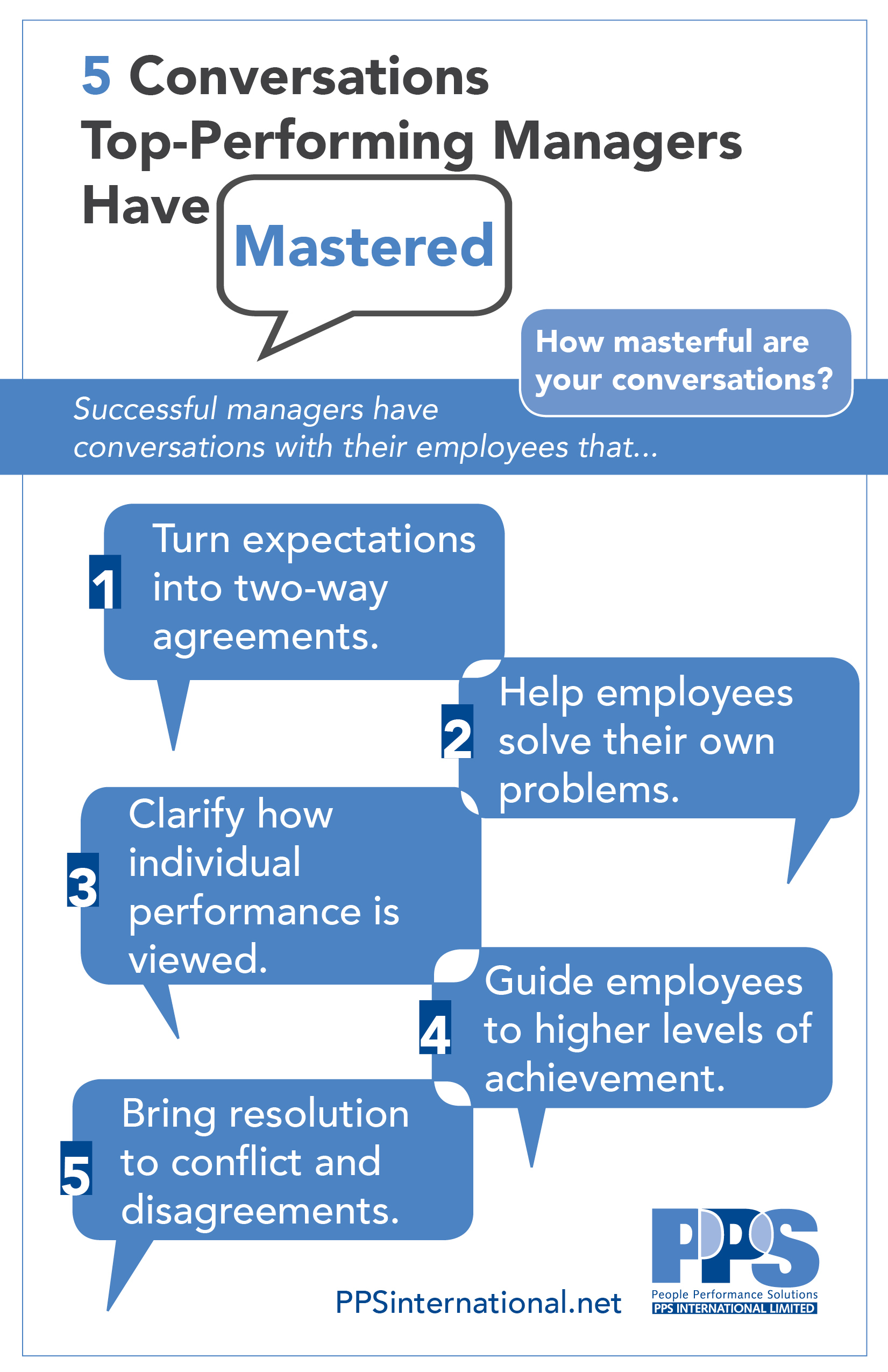
The infographic outlines the five conversations we see top-performing managers do well. This article describes each, including the discussion's purpose, what good looks like and the common mistakes, followed by a summary of when to hold each one and how to begin the discussion. It then shows how the five conversations fit into the performance cycle, the manager communication skills behind them and a self-check for managers. For talent development leaders, the last section covers building the five across a manager population as part of leadership development.
The five performance conversations top-performing managers have mastered
Successful managers have conversations with their employees that turn expectations into two-way agreements, help employees solve their own problems, clarify how individual performance is viewed, guide employees to higher levels of achievement and bring resolution to conflict and disagreements. Here is what each involves.
1. Turn expectations into two-way agreements
An expectation is something a manager holds, but may not have communicated to others. An agreement is something both people have discussed and accepted. In setting expectations, the manager describes what is to be achieved (the outcome), timing, why it is to be achieved, gives guidance on any methods to be used, discusses contingencies for potential derailers and sets follow-up. The employee raises questions and constraints, and both manager and employee leave the discussion with the same picture of what is needed and how progress will be checked.
For complex delegations or for situations where an employee may need more guidance, the agreement conversation provides specifics that help to avoid derailers. Consider making agreements about goals, for instance. Edwin Locke and Gary Latham's long-standing review of 35 years of goal-setting research found that specific, challenging goals led to higher performance than vague instructions such as "do your best," particularly when people were committed to the goal and received feedback on their progress [2]. The two-way part builds that commitment is that an employee who helped shape the agreement is more likely to own it.
The common miss in setting agreements is stating the expectation once and treating silence as agreement. Our Manager as Mentor & Coach program covers this conversation, and our Setting Expectations planning form can help managers prepare for it.
2. Help employees solve their own problems
When an employee brings a problem, the quickest response is to solve it. The more useful response, most of the time, is a coaching conversation: questions that help the employee work out the options and choose one, with the manager adding information or a view when it is needed. The employee leaves with a solution they own and a little more capability for the next problem.
In a good version of this conversation the manager asks more than they tell: what the employee has tried, what options they see, what they would recommend and what they need. The manager agrees on the next step and follows up. Coaching has limits, though; an employee facing an unfamiliar task may need direction first and coaching later.
A global medical device company with 30% year-over-year growth set out to build these skills when its new core values called for leaders to use active coaching skills. Managers needed a coach approach, including reflective listening, thoughtful inquiry and empathy, and needed to use coaching within the company's newly standardized performance management process, as our coaching skills for leaders case study describes.
The common miss is answering before asking, which teaches the employee to bring every problem back.
3. Clarify how individual performance is viewed
Employees often see their performance differently from how their manager and the organization see it, in either direction. This conversation closes that gap before it becomes a surprise at review time. The manager shares specific observations against the agreed expectations, asks for the employee's view and explains how the organization will judge the work.
How the feedback is framed makes a difference. A classic meta-analysis by Avraham Kluger and Angelo DeNisi found that feedback improved performance on average, but more than a third of the feedback interventions they studied were followed by lower performance, and feedback became less effective the more it drew attention to the person rather than the task [3]. Specific observations about the work, tied to the agreement from the first conversation, tend to land better than general judgments. Our guide on how to give positive feedback applies the same idea to acknowledging good work.
Our article on employee self-evaluations includes questions that help employees analyze their own results, and our appraisal discussion tool gives an agenda for the formal review.
The common miss is saving the view for the annual review.
4. Guide employees to higher levels of achievement
Once performance is solid, the question becomes what comes next: a stretch assignment, a new skill, a larger role or deeper expertise. The development conversation connects what the employee wants with what the organization needs and turns it into a plan with a few concrete actions.
In a good version, the manager asks about aspirations, shares a realistic view of readiness and helps the employee choose no more than three development actions, most of them on the job. Our guide to individual development plans covers the plan itself, and a feedforward discussion, which asks colleagues for suggestions about the future, is a useful way for the employee to gather ideas.
The common miss is treating development as a form completed once a year, rather than an ongoing discussion and process.
5. Bring resolution to conflict and disagreements
Disagreements between team members, or between the manager and an employee, tend to grow when left alone. The resolution conversation brings the disagreement into the open, separates the people from the problem, identifies what each person needs and agrees a way forward both can accept. When the conflict is between two team members, the manager may act as a mediator.
Our Managing Conflict program teaches a process for managing conflict through interactive problem solving, with mediation techniques when more than one person is involved. For the opening of a conversation someone will not want to have, our short video on how to begin a difficult conversation gives a structure.
The common miss is waiting for a better moment.
The five conversations at a glance
The table summarizes when to hold each conversation, one way to open it and the PPS program that builds skills related to the conversation.
| Conversation | When To Have It | A Way To Open It | Program That Builds It |
|---|---|---|---|
| Turn expectations into two-way agreements | At the start of a role, project or cycle, and when priorities change; any time you are delegating an assignment | "I'd like to get your agreement on something. Let me share what the goal is, some ideas I have for getting it done and hear some ideas from you." | Creating Accountability |
| Help employees solve their own problems | When an employee brings a problem or a decision | "What have you tried so far, and what options do you see?" | Manager as Mentor & Coach |
| Clarify how individual performance is viewed | Regularly, and well before any formal review | "I have some information to share with you that will be helpful. Before I share my insights, what do you see as going well with this?" | Conducting Performance Reviews and Giving & Receiving Feedback |
| Guide employees to higher levels of achievement | Once performance is solid, and at least once or twice a year | "It's important for us to invest in understanding your goals and how they fit with the organization so we can work toward both. Let's talk about where you want to be in two years, and what would stretch you toward it." | Manager as Mentor & Coach |
| Bring resolution to conflict and disagreements | As soon as a disagreement affects the work | "I think we see things from different points of view on this. I would like to understand how you see this before we decide anything." | Managing Conflict and Having Tough Conversations |
How the five conversations fit the performance cycle
The five conversations map onto the performance management process. Agreements come at the start of the cycle, coaching and feedback run throughout, the view of performance is confirmed at formal checkpoints, development planning follows as the cycle closes and conflict resolution happens whenever it is needed. The stages are not always linear: a coaching conversation in the middle of a quarter may reopen the agreement made at the start, and a development conversation may begin before the review.
The formal review is one performance conversation among many. When the other four happen regularly, the review tends to summarize what has already been discussed. Our guide to getting high performers from your performance management system describes the process managers are expected to run around these conversations.
The manager communication skills behind the five conversations
The five conversations draw on the same small set of manager communication skills, and a manager who struggles with one of them often struggles in several conversations at once. The skills include:
- Listening to understand before responding, and summarizing what was heard.
- Asking open questions that let the employee think the problem through.
- Giving specific feedback about the work instead of judgments about the person.
- Adapting to the employee's communication style, which our communication styles article explains.
- Staying calm and curious when the employee disagrees.
- Following up on what was agreed, in writing when it matters.
Our article on how to improve workplace communication covers the wider set, including what managers can do to improve team communication.
A self-check for managers
Managers can rate themselves on the ten statements below, two for each conversation: 1 for rarely, 2 for sometimes and 3 for usually. Circle or note a rating for each statement and add them up. A total of 25 to 30 suggests the conversations are well established, 18 to 24 suggests one or two need attention and a total below 18 suggests starting with the conversation that scored lowest.
| Statement | Conversation | Your Rating |
|---|---|---|
| Each person on my team can describe what is expected of them and by when. | Agreements | 1 2 3 |
| When I set an expectation, I ask what the person would change or needs from me. | Agreements | 1 2 3 |
| When someone brings me a problem, I ask what they have tried before I offer a solution. | Solving problems | 1 2 3 |
| My team members make more decisions on their own than they did six months ago. | Solving problems | 1 2 3 |
| I share observations about performance within days of seeing them. | Performance view | 1 2 3 |
| My team members are seldom surprised by what I say in a formal review. | Performance view | 1 2 3 |
| I know what each person on my team wants to achieve in the next two years. | Achievement | 1 2 3 |
| Each person has one to three development actions agreed with me. | Achievement | 1 2 3 |
| I address disagreements on the team when they first affect the work. | Conflict | 1 2 3 |
| When two people disagree, I help them reach an agreement instead of deciding for them. | Conflict | 1 2 3 |
The sixth conversation: managing up
There is a sixth conversation worth adding, and it runs in the other direction: the conversation your team members should be having with you: managing up.
Managers who make it easy for employees to raise their needs, priorities and concerns tend to find the other five conversations easier to hold.
For talent development leaders: building the five conversations across a manager population
When managers hold these conversations well, expectations are clear, problems are solved closer to the work and reviews hold few surprises. Our new manager training program guide calls performance conversations the place "where new (and incumbent) managers most often stall," especially if the new manager needs to hold a difficult conversation.
From industry to industry, regardless of manager tenure, managers at all stages of experience look for guidance in dealing with difficult conversations. To address this specific conversation, which blends feedback, coaching and sometimes poor performance discussions into one, an Americas OEM parts distributor client set about building skills in this area when they noticed situations such as rising employee complaints, confusion on expectations during change and scenarios being 'tossed' to HR rather than managers handling them on their own. PPS International Limited designed a very practical two-hour workshop, delivered both in person and virtually, on "Doing the Tough Stuff Well." Several hundred leaders at all levels of experience attended. The workshop was heavily based in skills practice to build confidence.
Cues that a manager population needs support with the five conversations include:
- Employees say in engagement surveys that they are unsure what is expected of them.
- Problems that team members could solve are escalated to managers or HR.
- Review ratings cluster in the middle, or surprise employees when they are delivered.
- Development plans are completed once a year and not revisited.
- Conflicts reach HR after they have affected the team for months.
A few practices we recommend for building the five across a population include:
- Teach the five as a set, with practice on participants' own situations and feedback from a facilitator.
- Build them into new manager programs, where the habits form, and refresh them for experienced managers.
- Involve the managers' own managers, who model the conversations and ask about them in their one-on-ones.
- Give managers a short planning tool for each conversation: a purpose, a few questions and a follow-up note.
- Reinforce with skill cards or job aids, such as our Leadership Conversations Skill Cards, for the conversations managers hold rarely or under pressure, one of the approaches in our list of ways to reinforce training.
- Measure with engagement items on clarity of expectations, multi-rater feedback on managers' conversations, the distribution of review ratings and escalations to HR.
Our programs for managers, including Manager as Mentor & Coach, Conducting Performance Reviews and Managing Conflict, build these conversations with practice and feedback, and our program list shows the rest.
Frequently asked questions
What is a performance conversation?
A performance conversation is any planned conversation between a manager and an employee about the employee's work: expectations, progress, problems, feedback, development or disagreements. The formal review is one of them. Most happen in regular one-on-ones and check-ins.
How often should managers have performance conversations?
Managers should have performance conversations far more often than the formal review. Many organizations aim for a short check-in every week or two, a more structured look at progress each quarter and a development conversation once or twice a year. The right cadence depends on the role and how quickly the work changes; a new employee or a new project usually needs more frequent conversations.
What is the difference between a performance conversation and a performance review?
A performance review is a formal, documented conversation, usually held once or twice a year, that summarizes performance and often feeds ratings or pay decisions. Performance conversations are the ongoing, less formal discussions between reviews. When they happen regularly, the review summarizes what has already been discussed and ties off on the performance plans for the cycle.
How should a manager prepare for a performance conversation?
To prepare for a performance conversation, decide which of the five conversations is most appropriate based upon the scenario. Gather two or three specific examples. Identify one desired outcome for the conversation and plan the conversation's opening sentence. Plan to ask check-in questions throughout and be sure to listen and summarize what the employee states before responding and adding more.
What if the employee disagrees?
If the employee disagrees, treat the disagreement as useful information. Ask the employee to explain their view and the evidence behind it, restate it to confirm understanding and look for the part both people agree on. If the disagreement is about the facts, agree how to check them; if it is about the standard, return to the agreement from your "expectations and agreement" conversation.
Where to start
Ask your managers which of the five conversations they dread the most, or look at which of the cues listed earlier point to. Start with building skill in that conversation by allowing for practice and providing a planning tool. For managers who are new to the role, begin with skill building on turning expectations into agreements, since the other four conversations assume and leverage that skill frequently.
Contact us if you want help building these conversations into your managers' skills, with practice and a planning tool for each one.
Start a conversation about performance conversations
References
- Clifton, J. and Harter, J. (2019). It's the Manager. Gallup Press.
- Locke, E. A. and Latham, G. P. (2002). Building a practically useful theory of goal setting and task motivation: A 35-year odyssey. American Psychologist, 57(9), 705–717. https://doi.org/10.1037/0003-066X.57.9.705
- Kluger, A. N. and DeNisi, A. (1996). The effects of feedback interventions on performance: A historical review, a meta-analysis, and a preliminary feedback intervention theory. Psychological Bulletin, 119(2), 254–284. https://doi.org/10.1037/0033-2909.119.2.254