As leaders, one of the most important ways to develop team members and build performance is giving specific, targeted feedback–either on-the-spot or through more formal means such as performance reviews and coaching sessions. While most leaders know the value in robust feedback, they also are challenged with providing it.
An employee self-evaluation is the employee's own assessment of their performance against the goals and standards for their role, usually completed before a performance review or check-in. Used well, it shows the manager where the employee's view matches theirs and where it does not, so the conversation can start from what the employee already sees. This article covers why self-evaluations and manager ratings differ, how to encourage self-analysis, self-evaluation questions, how employees can write an accurate self-evaluation and what to do when views still differ. If you lead talent development, the section for talent development leaders covers building self-evaluation into the performance process. The guidance draws on the feedback and communication training PPS International Limited delivers for clients.
Challenges in Giving Feedback
For instance, leaders with extensive spans of control or who have limited interaction with their direct reports may find giving feedback difficult; they lack concrete examples gathered over day-to-day interactions that would drive home their points. This happens more frequently if teams are interspersed across distance. Other times, leaders are managing their own steady-stream of projects and work, which presents a challenge to fit planning and giving feedback into already-packed schedules. Yet, there are those supervisors and managers who overcome these challenges only to be faced with another situation that can be difficult to navigate: employees who think their performance is better (or worse) than it truly is. This mismatch can stop managers in their tracks and create awkward, less-than-successful feedback discussions that miss the mark. We work under two feedback premises: (1) that feedback is information that describes an individual’s performance in relationship to a particular standard, and (2) that feedback’s intent is to reinforce or alter behavior—and therefore affects organizational results. If we view feedback from this perspective, ending up with a mismatch in what leaders and employees perceive as current performance is a significant stumbling block. After all, if employees disagree with your assessment of their performance, how encouraged do they feel to change? For sure the challenge is greatest when it presents itself as employees who think their performance is better than their managers do. But, opposite situations aren’t ideal either. The employee who never thinks he or she is doing well can end up focusing on areas that aren’t the highest return on effort of development. (Sometimes good is good enough.)
Why self-evaluations and manager ratings differ
Differences between how employees and managers see the same performance are common. A long-standing meta-analysis of 115 samples and more than 37,000 people found that self-ratings and supervisor ratings of job performance correlated at .22 [1]. A correlation that low means the two ratings tend to move in the same direction, but loosely. In Western samples, self-ratings also tended to be higher than supervisors' ratings [1]. Our article on how much weight to give self-assessments covers the research and self-reporting bias in more detail.
A classic set of studies by Justin Kruger and David Dunning helps explain why the gap can run in both directions [2]. People who scored in the bottom quarter on tests of grammar, logic and humor estimated their performance at the 62nd percentile when their scores put them at the 12th, while the strongest performers tended to underestimate how they compared with others. The knowledge needed to perform a skill well is often the same knowledge needed to recognize good performance, and when participants were trained in the skill, they became better at recognizing the limits of their own performance [2].
Other reasons are practical. Employees may not know the standard their manager uses, may weigh effort more heavily than results or may have received little feedback during the year. Many of these gaps narrow when the standard and the evidence are clear before the conversation, and when feedback is part of the ongoing performance conversations managers have throughout the year. When the gap reflects a real performance problem, our guide to handling employee performance issues helps diagnose the cause.
Dealing with Employees Who Don't Agree with Your Feedback
For those leaders who find themselves with plenty of data and specifics to illustrate their meanings, yet are faced with employees who simply don’t see their performance the same way as themselves, here are some ways to encourage self-analysis:
- Tip off your employees to get and stay organized and up-to-date on their performance. Remind them to keep track of progress, ongoing notes, assessment results and other points of feedback so that they can review them prior to feedback conversations, both formal and informal. Encourage them to ask for feedback from sources other than just you including customers, internal partners and peers.
- For formal feedback situations such as performance reviews, ask employees to schedule specific time to reflect on their own performance before any conversations occur. Even 15 minutes is enough time to consider strengths and development areas. Self-review works best inside a performance management system that managers know how to run. Encourage this time by providing coverage for employees whose roles don’t allow for flexibility in scheduling (for instance, for call center representatives, cover their lines).
- Point out that you expect and encourage them to find at least two things they are doing well (and should maintain) and at least one thing they see as needing upgrade or enhancement. Ask employees to think through any actions they can take to maintain or improve overall results. A simple tool to support this is to prompt with questions such as, “What did you plan to accomplish and how much or little did you do to accomplish these goals?” Or, “What areas of responsibility do you readily take on? Find challenging?”
Questions to Help Employees Analyze Their Performance
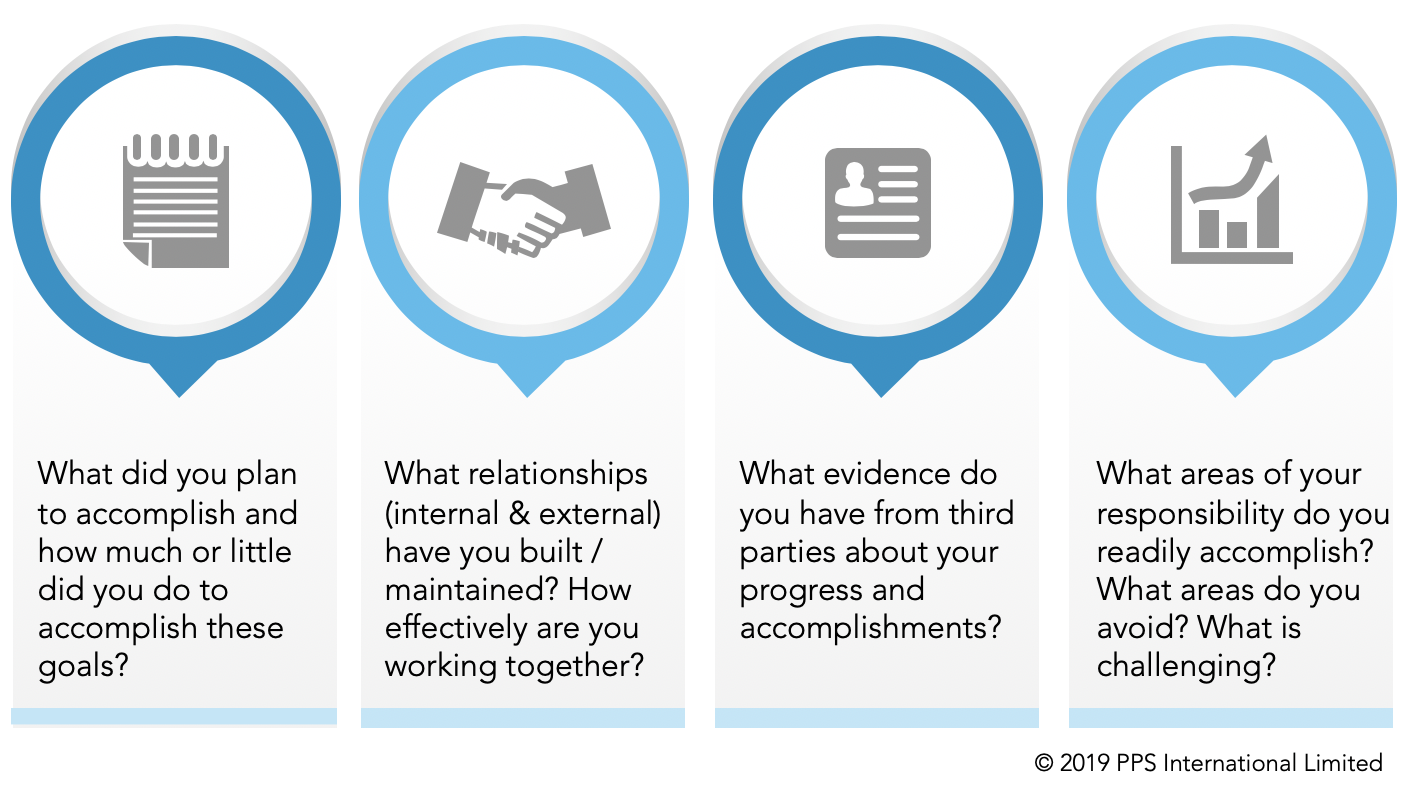
The four questions in the image are:
- What did you plan to accomplish and how much or little did you do to accomplish these goals?
- What relationships (internal and external) have you built or maintained? How effectively are you working together?
- What evidence do you have from third parties about your progress and accomplishments?
- What areas of your responsibility do you readily accomplish? What areas do you avoid? What is challenging?
Here are a few more self-evaluation questions, grouped by area:
| Area | Questions to Ask Yourself |
|---|---|
| Goals and results | "Which goals did I meet, exceed or miss, and why?" "What results can I point to?" |
| Quality of work | "Where did my work need corrections or rework?" "What feedback did I receive on quality?" |
| Working with others | "Who relies on my work, and what would they say about it?" |
| Development | "What new skill did I build during this period?" "What would help me most in the next one?" |
| Support needed | "What resources or support do I need to reach my goals?" |
Two practices help managers make the most of these questions:
- As part of your preparation for giving feedback, share a simple discussion agenda and ask employees to make their own notes for the conversation.
- When giving feedback, let them go first in the discussion. Set the expectation that during the discussion you want to hear from your employees first about what is working and what isn’t before you add to or reinforce their findings. This will allow you to better know where misalignment is before you share your feedback. It also sets the tone that the employee is responsible for his or her feedback.
How employees can write an accurate self-evaluation
A self-evaluation is most useful when it is specific and balanced. If you are writing your own, here are a few guidelines:
- Start from your goals and the standard for each. Review the goals agreed at the start of the period, so your evaluation measures performance against the same expectations your manager uses.
- Use evidence. Include specific results and examples, along with feedback from customers, internal partners and peers.
- Identify at least two strengths and one area to develop. Strengths show what to maintain; a development area shows where you want to grow.
- Describe what you did and its effect. Specific actions and results are easier for a manager to discuss than general statements about effort or attitude.
- Include what did not go as planned. Say what you learned from it and what you would do differently. A self-evaluation that lists only successes may be harder for a manager to trust.
- Keep it concise. A short, specific self-evaluation is easier for your manager to read and discuss before the conversation.
Here are a few example self-evaluation statements:
- "I met three of my four quarterly goals. The vendor onboarding goal slipped by six weeks because contract approval took longer than planned; next quarter I will start approvals earlier."
- "Customers rated my support tickets 4.7 out of 5 on average this year, and two internal partners asked me to train their new hires on the ticketing process."
- "I want to improve how I manage my own follow-ups with vendors. On two projects I followed up only after my manager asked, which delayed completion."
- "Presenting to senior leaders is an area I find challenging. I would like to build that skill through a presentation course and practice in our team meetings."
When views still differ
Even using these strategies, it’s possible that managers and direct reports will still be misaligned, and in that case, be frank:
- If misalignment comes up, don’t shy away from it. Disclose, “We don’t see things the same way on this point. I think it’s important for us to better understand this gap. How about you tell me what your thinking is and then I’ll share mine.” Then, listen and summarize their points before launching into your own. In most cases, you want to be brief on what is different, starting with the standard you would expect. For example, “The goal is for you to be able to manage your own task list and follow up on open action items without prompting from me or others. What I notice is that on the past two projects, you didn’t follow up with vendors until I asked you to do that as part of our touchbase meeting. This leaves me with responsibility for your tasks and ultimately delays your progress on completion.” Frankness and clarity are helpful to alignment.
After the conversation, a few steps help narrow the gap over time:
- Agree on the standard. Make sure you and the employee describe the expected result in the same terms, as in the example above.
- Agree on the evidence to review together. Identify what will show progress, such as completed tasks, customer feedback or project milestones.
- Set a follow-up date. Schedule a check-in within a few weeks to review the evidence together.
- Document the conversation. Summarize what was agreed, including any points on which you still see things differently.
In the end, when giving feedback you may not create alignment on perceptions, but these approaches improve the possibility for understanding and ultimately, change in performance. They also encourage a spirit of self-awareness in employees. And, self-awareness is critical to any development.
For talent development leaders: building self-evaluation into the performance process
Talent development leaders often wonder how to make self-evaluation a useful part of the performance process for every manager and employee. Here are a few things to consider from the point of view of talent development:
- Recognize and share value to the organization for building self-evaluation into the performance process. Self-evaluations give managers the employee's view before the conversation, involve employees in their own development and can reveal where standards are unclear.
- Look for cues that self-evaluation is not working. Common cues include self-evaluations completed at the last minute or left blank, reviews in which the manager does all the talking, frequent disagreement about ratings and employees who are surprised by their review.
- Consider how to build the skill at scale. Give employees the questions and examples well ahead of the conversation, prepare managers to let employees go first and to discuss differences, and keep the form short. The employee version of our Giving & Receiving Feedback program covers how to self-analyze your own performance and ask your manager and others for feedback.
- Be aware of how other organizations solve for misaligned views of performance. Many organizations ask employees and managers to rate the same behaviors and discuss the differences, and they keep self-ratings out of pay and promotion decisions on their own.
Frequently asked questions
What is an employee self-evaluation?
An employee self-evaluation is the employee's own assessment of their performance against the goals and standards for their role, usually completed before a performance review or check-in. It gives the manager the employee's view before the conversation.
What should I write in my self-evaluation?
In your self-evaluation, describe your results against your goals with specific evidence and identify at least two strengths and one area to develop. Also note the support you need, and keep it balanced and concise.
How should managers use self-evaluations?
Managers can use self-evaluations to see where the employee's view matches theirs before the conversation, then let the employee go first and discuss the differences. The self-evaluation is a starting point for the conversation.
What if an employee rates themselves too high or too low?
If an employee rates themselves too high or too low, start with the standard and the evidence. Ask the employee to explain their view, summarize it, then briefly share yours with specific examples, as described in "When views still differ" above.
Should self-evaluations affect ratings or pay?
Self-evaluations should inform the conversation more than the rating. We recommend keeping self-ratings out of pay and promotion decisions on their own, because they tend to be lenient and people may rate themselves differently when the stakes are high.
How long should a self-evaluation take?
How long a self-evaluation takes depends on the form, but even 15 minutes of reflection is enough to consider strengths and development areas. Schedule the time before the conversation, and provide coverage for employees whose roles do not allow flexible scheduling.
Where to start
Before your next round of performance conversations, share the self-evaluation questions above with employees and schedule time for them to reflect. If you are building these skills across managers and employees, our feedback skills program for managers and employees covers both sides of the conversation.
Start a conversation about employee self-evaluation
References
- Heidemeier, H. and Moser, K. (2009). Self-other agreement in job performance ratings: A meta-analytic test of a process model. Journal of Applied Psychology, 94(2), 353-370. https://doi.org/10.1037/0021-9010.94.2.353
- Kruger, J. and Dunning, D. (1999). Unskilled and unaware of it: How difficulties in recognizing one's own incompetence lead to inflated self-assessments. Journal of Personality and Social Psychology, 77(6), 1121-1134. https://doi.org/10.1037/0022-3514.77.6.1121