HR and Training Professionals are important resources to ensure that organizational changes are managed well. We know that change occurs in our organizations for a variety of reasons including:
- Mergers, acquisitions and divestitures;
- Updates and adjustments to company-wide policies;
- New senior leaders joining the organization;
- Upgrades to technology;
- Reorganization or restructuring of departments or entire units;
- Start-up of new services and products;
- Introduction or adjustment of processes;
- Growth or downsizing of the workforce.
Organizations generally implement these changes because they want to improve their results: quality, sales, productivity, efficiency and achievement of mission. Yet, when changes are implemented without considering a few of the key aspects needed for change success, organizations may not realize results. It could be that productivity plummets at the first hint of change and continues, often for months after a change is implemented.
A change management plan is the document that prevents that drop. It sets out what is changing and why, who is affected and how, who sponsors and leads the change, how people will hear about it, what they need to learn, how the change will be reinforced and how the organization will know it worked. This article walks through the three phases we use to develop one, the components of the plan, a template you can fill in, a worked example from a published PPS engagement and the measures that show whether productivity held through the change.
What a change management plan is, and what it is not
A change management plan covers the people side of a specific change: the stakeholders, communication, training, reinforcement and measurement that move an organization from announcement to adoption. It sits alongside the project plan, which covers the technical or operational work (the system build, the new structure, the policy), and it is narrower than a change management strategy, which is the organization's general approach to change across many initiatives. The distinction matters in practice. A project plan without a change management plan produces a system that is installed and not used, a structure that exists on paper and a policy that is announced and quietly ignored.
The research behind the practice is older than the templates. Kurt Lewin described change as unfreezing current behavior, moving and refreezing the new behavior so it holds [1]; most of what follows is about the third step, which is the one plans most often skip. John Kotter's eight steps, from establishing urgency to anchoring the change in the culture, remain the most cited sequence for leading a large change [2]. William Bridges separated the change, which is the external event, from the transition, which is the internal process people go through to let go of the old way and take up the new one [3]. A plan that schedules only the change and not the transition is the usual reason productivity falls.
How to develop a change management plan
Once your leadership team has identified an idea or need for change, developing and implementing a change management plan with a focus on how the changes will create future success for your organization is key. Taking time to develop these plans ahead ensures you have tools and resources in place to manage the process and support employees through the changes.
When you make these plans, focus on three phases:
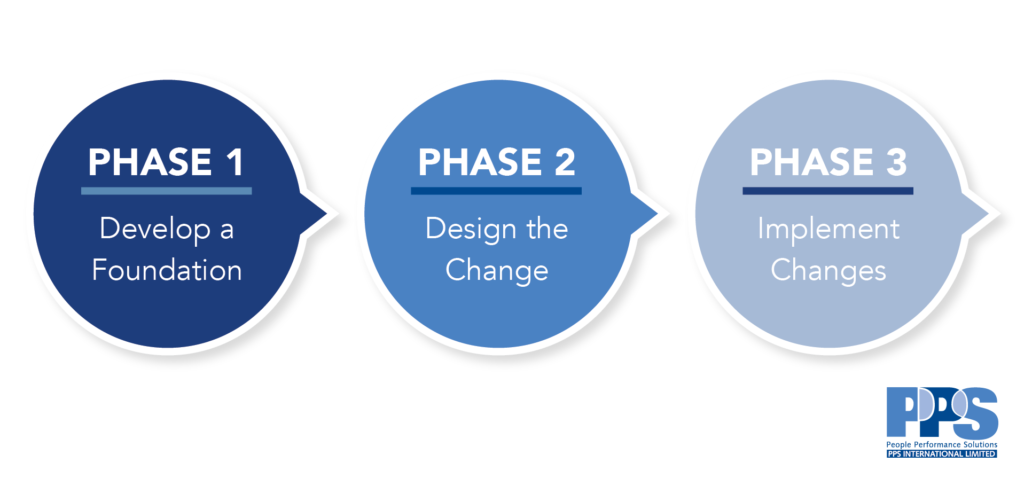
Phase 1: Develop a foundation
Lay the groundwork for your changes by identifying key factors such as:
- The purpose or goals of the changes.
- Your change "stakeholders" and how you can partner with them.
- Ways to collaborate with customers and "end users."
- Ways to create internal commitment and capability to implement the change.
In the plan, this phase produces four things: a one-paragraph case for the change in business terms, a stakeholder map that lists each group, what changes for them and what they are likely to worry about, a sponsor and a change lead with defined responsibilities, and a readiness read. The readiness read can be a short survey, a set of conversations with managers or a formal change readiness assessment; what matters is that it happens before the announcement, so the plan is built on how people feel rather than on how the sponsor hopes they feel. Where bargaining units and works councils are present, involve them in this phase, since consultation requirements often set the calendar.
Phase 2: Design the change
Once you have a framework for your changes and have identified key factors that can aid in successful implementation, define how the change will take place. Focus on these elements to design an effective change process:
- Leverage organizational strengths and plan to address areas that will likely be issues.
- Publicize the core purpose and your vision for the future. Repeat and reinforce frequently.
- Identify any changes needed to improve performance.
- Provide adequate training to educate and prepare your employees. When the change is a culture shift, our development process for organizational culture change shows how training supports it.
In the plan, this phase produces the communication plan (who hears what, from whom, through which channel, how often and where questions go), the training plan (which groups need which skills, when, and in what format, timed close to the moment people need them rather than months ahead), the manager toolkit (what first-line managers say in team meetings and one-on-ones, since employees hear the change from their manager whatever the corporate channel says) and the reinforcement plan. Our article on reinforcing training covers the reinforcement methods that carry a new behavior past the launch window.
Phase 3: Implement change
Once a complete plan is developed, be sure to focus on:
- Sticking to your agreed-upon implementation plan.
- Tracking results.
- Evaluating the effect of the changes.
- Recognizing the results you've achieved.
In the plan, this phase is a calendar with owners: the launch, the communication cadence, training dates by group, manager check-ins, the dates on which the measures are read and the point at which the change is declared complete and handed to normal operations. Recognition belongs in the calendar too. Teams that hear what they have achieved at 30, 90 and 180 days keep going; teams that only hear what is still wrong do not.
Components of a change management plan
Here are the components we expect to see in a complete plan, with the phase that produces each and the person who usually owns it:
| Component | What It Contains | Phase | Typical Owner |
|---|---|---|---|
| Case for change | What is changing, why now, what happens if nothing changes, in business terms | 1: Develop a foundation | Sponsor |
| Scope and impact | Which groups, roles, sites and processes change, and how much | 1: Develop a foundation | Change lead with the project lead |
| Stakeholder map | Each group, what changes for them, likely concerns, how they are engaged | 1: Develop a foundation | Change lead |
| Sponsorship and roles | Sponsor, change lead, manager responsibilities, any change champions | 1: Develop a foundation | Sponsor |
| Readiness read | Survey, conversations or a change readiness assessment, and what it found | 1: Develop a foundation | HR or talent development |
| Communication plan | Messages by audience, sender, channel, timing and the route for questions | 2: Design the change | Change lead with communications |
| Training plan | Skills by group, format, timing and who delivers | 2: Design the change | Talent development |
| Manager toolkit | Talking points, meeting agendas, one-on-one questions, escalation route | 2: Design the change | HR or talent development |
| Reinforcement plan | What happens after launch to keep the new behavior: check-ins, coaching, recognition, job aids | 2: Design the change | Managers, supported by talent development |
| Measures and baseline | The adoption, productivity and sentiment measures, with the pre-change baseline | 2: Design the change | Change lead |
| Implementation calendar | Dates, owners, review points and the handover to operations | 3: Implement change | Change lead |
| Risks and responses | What could stall the change and what the response is | All phases | Change lead |
A change management plan template
The table below is the plan in fill-in form. Each row is a section of the document; the prompts are the questions the section answers; the third column shows what an entry looked like for the rollout described in the example that follows. Copy the rows into your own document, answer the prompts in a sentence or two each and you have a first draft that the sponsor can react to.
| Section | Prompts To Answer | Example Entry |
|---|---|---|
| 1. Case for change | What is changing? Why now? What does the business gain, and what does it lose if nothing changes? | Manufacturing sites are moving to a data-driven operation; employees need a working grasp of data and analytics and how digital tools change their work |
| 2. Scope and impact | Which sites, roles and processes change, and how much for each? | All manufacturing employees across sites and languages; learning time available only during shifts |
| 3. Stakeholders and concerns | Who is affected, what will each group worry about, and how will you find out? | Employees (what this means for my job), supervisors (shift coverage), bargaining units and works councils (approval of learning time) |
| 4. Sponsorship and roles | Who sponsors the change, who leads it day to day, and what do managers own? | Operations leadership sponsoring; manufacturing supervisors coordinating learning within shift patterns |
| 5. Readiness | What did people tell you before the announcement, and what does that change in the plan? | Learning has to be approved by employee-representation bodies and fit shifts, so the calendar starts with those approvals |
| 6. Communication plan | Which messages, to whom, from whom, through which channels, how often, and where do questions go? | Site-specific messaging through each location's own channels, in the local language, coordinated by supervisors |
| 7. Training plan | What does each group need to be able to do, in what format, and when relative to the change? | Eight 15-minute modules mixing video, reading, problem-solving with real data and group discussion, self-directed on a platform, with supervisor-led discussion |
| 8. Manager toolkit | What do managers say and do in the first weeks, and how do they escalate problems? | Supervisors built into the delivery path with discussion guides connecting the content to each site's reality |
| 9. Reinforcement | What keeps the new behavior alive after launch: check-ins, coaching, recognition, job aids, updates? | Content updated as participants succeeded with the data tools; platform engagement reports for program owners |
| 10. Measures and baseline | What will you measure, where does the data come from, and what is the number today? | Use of data tools by the trained population, with engagement and completion reports; baseline usage before rollout |
| 11. Calendar and owners | Launch date, communication cadence, training windows by group, review dates, handover to operations | Initial rollout to 2,500 employees, then expansion to all manufacturing employees |
| 12. Risks and responses | What could stall this, how would you know, and what is the response? | Shift coverage and approval delays; addressed by starting the approval work first and scheduling within shifts |
A change management plan example
Here is the engagement behind the example entries above, read as a change management plan rather than as a training project. A global pharmaceutical and consumer products organization wanted its manufacturing workforce ready for a more data-driven operation: a technology and process change that touched every site. The audience was large, spread across sites and languages, could learn only during shifts and in many cases needed learning time approved by bargaining units and works councils. Our partner SyNet EMEA led the engagement.
- Foundation. The purpose was defined in business terms (a data-driven operation) and in people terms (a common vocabulary, recognition of the basics of data and analytics and a digital mindset that leads to an institutionalized digital culture). The stakeholder work identified the constraints that would shape everything else: shift patterns and employee-representation bodies.
- Design. The change reached employees through a curriculum of eight 15-minute modules that combined short videos, reading, problem-solving activities that put data in employees' hands and group discussions that connected the learning to each site's reality. Delivery was self-directed on a platform, coordinated through manufacturing supervisors so it fit shifts, in multiple languages, with site-specific messaging through each location's own channels. Supervisors were built into the delivery path, which is often how a change best reaches a shift-based workforce.
- Implementation. Measurement was designed in from the start, so the organization could see engagement instead of guessing at it. The initial rollout trained 2,500 employees, the audience was then expanded to all manufacturing employees, and use of data tools increased by 31% in the population trained. As participants had success with the tools, the program was updated, which is what reinforcement looks like when it is planned.
The microlearning case study covers the curriculum design in detail. Read as a plan, the lesson is that the constraints found in phase 1 (shifts, languages, approvals) decided the design in phase 2, and that the measure chosen in phase 2 (tool usage) is what made phase 3 reportable.
Keeping productivity up during the change
Productivity drops during change for reasons a plan can address: people spend attention on what the change means for them, rumor fills the gaps that communication leaves, roles and decision rights go unclear for weeks, and the new skills arrive either too early to be remembered or too late to be useful. Here are the practices we build into plans to hold productivity:
- Communicate through managers, on a cadence. Corporate announcements set the frame; the conversation that decides how people feel happens in team meetings and one-on-ones. Give managers the words and common questions, and a route for getting answers for anything that they cannot answer. For an acquisition that doubled a client's revenue and headcount, we built a set of agendas and tools managers used to facilitate meetings before, during and after the acquisition: checking in on engagement, building common ways of working, creating team operating agreements, integrating knowledge and creating team alignment. Our change management consulting page describes that work and others like it.
- Say what is fixed, what is open and when the open questions will be decided. People can work inside a decision date; they cannot work inside silence. Our tool on dealing with ambiguity covers the same practice at the individual level.
- Time training to need. Skills taught three months before the system arrives are gone by launch. Plan the training windows against the implementation calendar, and keep job aids and short refreshers available afterward. When 5,000 leaders in one defense subcontractor organization had to lead a remote and hybrid workforce for the first time, the support was a remote leadership curriculum of microlearning videos and infographics they could use as the need arose, rather than a single course.
- Protect the work that must not slip. Name the two or three outputs that have to hold through the transition and give them explicit priority over change activities; a launch that stops shipments teaches the organization to fear the next one.
- Watch for change fatigue. Organizations that run several changes at once see the productivity drop compound. The plan should show the other changes landing on the same groups in the same quarter, and the sponsor should decide the sequence.
- Build resilience and decision skills before the change lands. Where the change is prolonged, our Managing Uncertainty and resilience programs prepare leaders for taking action without full information and sustaining their teams' capacity; our video on leading in a VUCA world covers the organizational view.
Measuring whether the plan is working
A change management plan is judged by adoption and by what happened to productivity, not by the number of communications sent. A few measures we recommend, with the baseline taken before the announcement:
| Measure | What It Tells You | Source |
|---|---|---|
| Adoption or usage of the new system, process or behavior | Whether the change happened, by group and site | System data, observation, audits |
| Productivity indicators the business already tracks (output, cycle time, error or rework rates, service levels) | Whether productivity dipped, how deep and how long | Operations dashboards |
| Sentiment and understanding pulse | Whether people understand the change and how they feel about it, over time | Three-question pulse, repeated |
| Manager conversation completion | Whether the manager cadence is happening | Manager checklist |
| Training completion and application | Whether people were prepared and are using the skills | LMS and a 30-to-60-day application question |
| Escalations, grievances, voluntary exits in affected groups | The cost of the transition, and where it concentrates | HR records |
Read these at 30, 90 and 180 days after launch and once more at the handover to operations. Our article on training effectiveness measurement covers how to set the baseline and choose the comparison, and our article on talent management metrics shows how change measures sit in a leadership scorecard.
Where change management plans go wrong
- The plan is written after the announcement. By then the rumor has set the frame, and the plan spends its first month correcting it.
- Communication is one email. A change is understood on the fourth or fifth hearing, from a manager, in the employee's own terms.
- Managers are informed at the same time as their teams. They cannot answer questions they are hearing for the first time; brief them first and give them the toolkit.
- Training is scheduled by the project plan rather than by need. Too early and it is forgotten; too late and people have already built workarounds.
- Nothing is planned for after launch. Reinforcement, recognition and updates are the difference between a change that holds and one that reverts, which is Lewin's refreezing in practice.
- Activity is measured instead of results. Emails sent and sessions delivered describe effort; adoption and productivity describe the outcome.
- The change is treated as an event. Making effective organizational change is a process rather than an event. Many organizations seek a quick fix to transitions; yet rarely do those exist.
Frequently asked questions
What is a change management plan?
A document that covers the people side of a specific organizational change: the case for the change, the stakeholders and their concerns, sponsorship and roles, communication, training, the manager toolkit, reinforcement, the measures and baseline, the implementation calendar and the risks. It sits alongside the project plan, which covers the technical or operational work.
What are the steps in a change management plan?
We use three phases: develop a foundation (purpose, stakeholders, end users, commitment and capability), design the change (strengths and issues, the core purpose repeated and reinforced, performance changes, training) and implement the change (stick to the plan, track results, evaluate the effect, recognize the results). The components table above lists what each phase produces.
What is the difference between a change management plan and a change management strategy?
A strategy is the organization's general approach to change: its principles, governance, roles and standard tools across initiatives. A plan applies that approach to one specific change, with specific stakeholders, dates and measures. Organizations without a strategy still need a plan for each change; organizations with a strategy write plans faster.
What should a change management communication plan include?
For each audience: the messages, the sender (usually the manager for the conversation that matters most), the channel, the timing and frequency, the route for questions and the feedback loop that tells you what people understood. Site-specific messaging in the local language and through local channels tends to outperform a single corporate broadcast.
Do we need Kotter's eight steps?
Kotter's sequence, from creating urgency and building a guiding coalition through generating short-term wins and anchoring the change in the culture, is a useful check on any plan for a large change [2]. The three phases above cover the same ground in the order a talent development team works: the urgency and coalition belong in the foundation, the vision and communication in the design, the wins and anchoring in the implementation and reinforcement.
How do you keep productivity up during organizational change?
Communicate through managers on a cadence, say what is fixed and what is open and when it will be decided, time training to need, protect the outputs that must not slip, watch for change fatigue across concurrent changes and measure productivity indicators the business already tracks so a dip is seen early. The section above expands each.
Where to start
Development and execution of a solid process can help to increase productivity and decrease potential "fall-out" when your organization is facing changes. As you prepare, consider trusting your change management process to a team of professionals. We may not always consider that those who are specialists in developing leaders and others are typically very astute in motivating and preparing others to change. After all, they know how to communicate, teach and reinforce personal change efforts; these same skills help with organizational change efforts.
The goal in working with a change management expert is to ensure your organization reaps the benefits it desires from a change. By implementing change-support initiatives built around the three-phase collaborative change process, there can be a simple, yet effective roadmap to better outcomes. Fill in the template above for the change in front of you, take the baseline before the announcement and brief the managers first. If you would like support, our change and transition team works alongside HR and talent development teams on all three phases; contact us to talk through your change.
References
- Lewin, K. (1947). Frontiers in group dynamics. Human Relations, 1(1), 5–41.
- Kotter, J. P. (1995). Leading change: Why transformation efforts fail. Harvard Business Review, March–April 1995 (reprinted January 2007).
- Bridges, W. and Bridges, S. (2017). Managing Transitions: Making the Most of Change (25th anniversary ed.). Da Capo Lifelong Books.