It is true that training and development alone cannot change organizational culture. It takes steady focus and organization-wide alignment to be able to make culture shifts. However, training and development does have a role to play when it comes to shaping culture.
If organizations are interested in educating leaders and enabling them to be more efficient in their leadership practices, while at the same time creating sustainable behavioral change at all levels of the organization, training and development is almost certainly required.
Successful development that supports organizational change should be iterative, building upon itself over time. It should have individual and group experiences that are tied to team performance. And, it should allow for individuals to practice and build skills.
This guide is written for the HR, organizational development and talent development leaders who are asked to support a culture shift. It covers what organizational culture change requires, the team-based development process PPS International Limited uses to support it and how to manage and measure the shift. Examples from our client work and answers to common questions follow.
What organizational culture change requires
Organizational culture is the set of shared assumptions a group learns as it solves its problems and then passes on to new members as the way things are done here [1]. In practical terms, it shows up as the behaviors people repeat when no one is checking: how decisions get made, how feedback is given, what gets recognized and what gets ignored. Because culture lives in repeated behavior, changing it means changing what people do day to day and what the organization reinforces, not only what it says it values.
In our experience, a culture shift that holds tends to have four conditions in place:
- A definition of the shift in behavioral terms. "More accountability" is a value. "Managers hold monthly performance conversations and follow through on the agreements made in them" is a behavior that can be taught, observed and measured.
- Sponsorship and alignment at the top that lasts beyond the announcement. Senior leaders participate first and are seen practicing the new behaviors.
- Systems that reinforce the behaviors, including performance management, recognition, onboarding and promotion criteria.
- Development that builds the skills and the shared vocabulary the new behaviors require, delivered where the culture is experienced: in teams.
Two lines of thinking support this order of work. Michael Beer of Harvard Business School argues that culture changes as a result of doing real work in line with a new strategy, governance model or performance management system, rather than through direct appeals to change the culture itself [2]. John Kotter placed anchoring new approaches in the culture as the last of his eight steps for leading change, after new behaviors have produced visible results [3]. Development is the part of that sequence that builds the behaviors, and the culture comes to reflect them over time.
Why training alone cannot change culture, and why it is still required
Training on its own tends to fall short for reasons that have little to do with the quality of the training:
- It does not change the incentives. If throughput is rewarded and coaching is not, supervisors return to throughput.
- It is often delivered to individuals, while culture is experienced in teams. A manager who returns from a workshop with new practices meets a team that has not changed its expectations.
- It tends to be an event. A single workshop, however well received, has no cadence behind it, and new behaviors fade without practice and reinforcement.
- It may skip the senior team. When executives sponsor a program they did not attend, participants notice.
At the same time, we have not seen a culture shift succeed without development. New behaviors require skill, and skill requires practice with feedback. Leaders need a common vocabulary for the behaviors and a way to give feedback on them. Teams need time together to agree on how they will work. A recent Harvard Business Review piece makes a related point: education campaigns on their own rarely produce measurable behavior change, and concentrating on a single high-impact behavior tends to work better than broad appeals [4]. That is the role of training and development in a culture shift: to build a small number of defined behaviors, in intact teams, with practice and reinforcement, inside the business cadence.
The manager's role deserves a specific mention. In a 2019 SHRM survey, 76% of American workers said their manager sets the culture, and one in five had left a job in the previous five years because of the culture, at an estimated turnover cost of $223 billion [5]. Managers are the population where a culture shift becomes real for employees, which is why the development process below works at the team level and equips managers to reinforce the shift.
A development process that shifts culture
Because visuals can be useful, here is an example process, geared towards a team-based approach to learning:
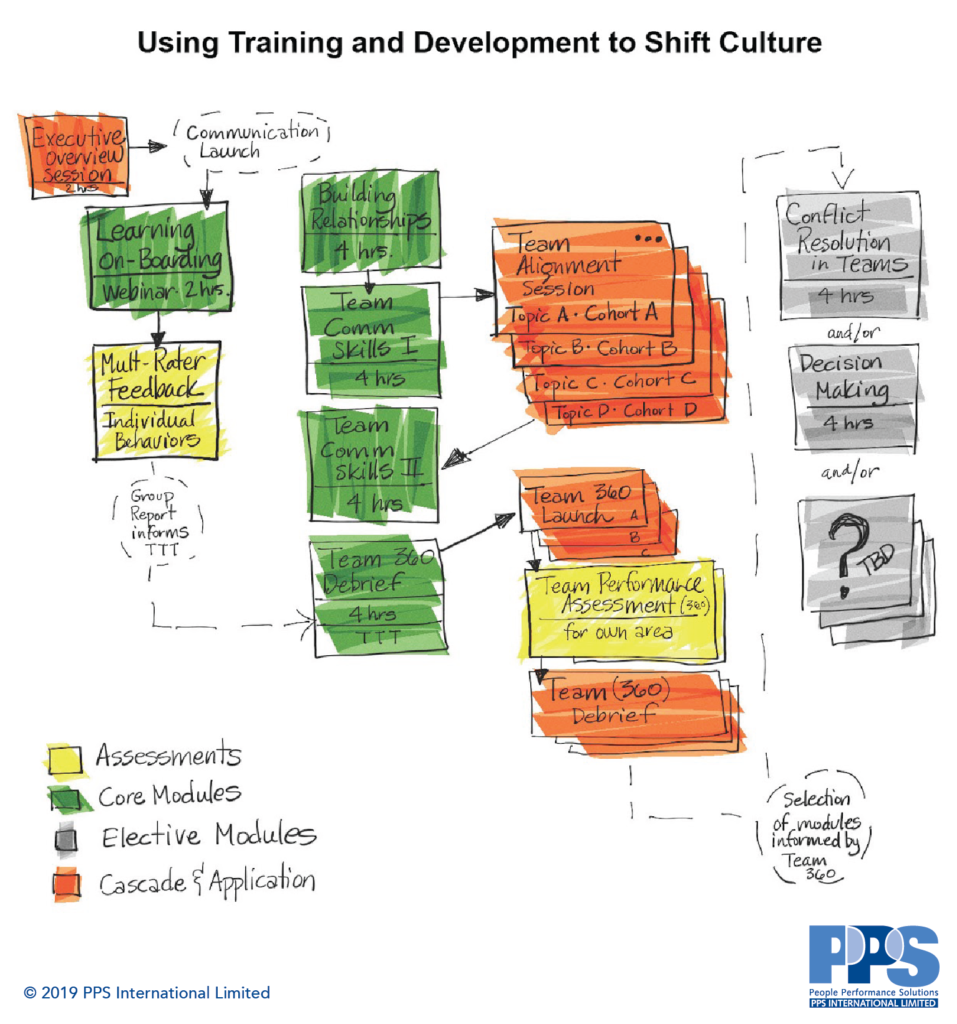
Using a framework, such as the one outlined above, allows your internal team to create a focused and customized approach to team development. By including a mix of assessments, targeted learning opportunities and full-team sessions, you can create a process that fits the unique needs of your organization and the shifts you are looking to make in your organizational and operational culture.
Here is what each element of the process does and what it produces.
| Element | Purpose | What It Produces |
|---|---|---|
| Executive launch | Senior leaders define the shift in behavioral terms, explain why it matters to the business and commit to participating first. | A short list of target behaviors, visible sponsorship and a decision on which teams start. |
| Onboarding and multirater feedback | Each participant learns how the process works and receives 360-degree feedback on the target behaviors from their manager, peers and direct reports. | An individual baseline, a development plan and a group report that shows where the population stands. |
| Relationship and team communication modules | Skill-building workshops on the behaviors the data shows are weakest, with practice and feedback in the room. | Shared vocabulary and demonstrated skill in the behaviors the shift depends on. |
| Team alignment sessions | Intact teams, with their leader, agree on how they will work together: decision rights, meeting practices, feedback norms and how they will hold each other to the agreements. | Team operating agreements and a review cadence. |
| 360 reassessment | The same multirater instrument is repeated after the teams have practiced for a period. | Evidence of movement on the target behaviors, by individual and by group, and the priorities for the next phase. |
| Optional modules | Conflict resolution, decision making or other topics, selected from the reassessment data rather than scheduled in advance. | Targeted skill-building where the data shows the shift is stalling. |
A few design principles run through the process:
- It is iterative. Each phase uses the data from the last one to decide what comes next.
- It is tied to team performance. The alignment sessions and operating agreements connect the behaviors to the work the team is measured on.
- It builds in practice. Workshops include practice with feedback, and the period between phases is for application on the job with the manager's support.
Work in phases
A culture shift is a multi-year effort, and the process above is designed to run in phases within the business cadence rather than as a single program. A typical sequence for a business unit or function looks like this:
- Phase 1: executive launch, onboarding, the first multirater assessment and the first skill-building modules for the senior team and the first wave of intact teams.
- Phase 2: team alignment sessions, application on the job with manager reinforcement and the first reassessment.
- Phase 3: additional waves of teams, optional modules chosen from the data and alignment of the surrounding systems, such as performance management and onboarding, with the target behaviors.
Organizations can extend the process into further phases by adding cohorts, individual coaching for leaders whose reassessment shows little movement and support tools for managers.
How to design the process for your organization
Here are a few guidelines that help when adapting the process to your organization:
- Start with a business problem rather than with the culture. Choose the unit where current behaviors are limiting a result the business cares about, such as retention on a production floor or decision speed in a newly merged team, and define the shift there.
- Write the target behaviors as observable practices. Three to five behaviors is enough. More than that dilutes focus and makes measurement difficult.
- Choose assessments that measure the behaviors. A custom 360-degree instrument written to the target behaviors is the most direct measure. Style inventories such as Interaction Styles® or Everything DiSC® help individuals understand how their preferences land on others, and a team instrument such as the Team Success Questionnaire gives an intact team a shared picture. Our assessments page describes the instruments we use and when each fits.
- Build the learning around the behaviors rather than around a curriculum. A few high-application modules, each with practice and a workplace assignment, tend to produce more change than a broad program. Too much content stretched over too much time creates a shallow program that struggles to get results.
- Run the team sessions with intact teams and their leader. A mixed cohort builds skill. An intact team changes how it works.
- Equip managers to reinforce. Give them a short set of prompts for one-on-ones and team meetings, and make the target behaviors part of their own performance conversations. Our guide to reinforcing training covers the practices we see work.
- Sequence the work into the business cadence. Schedule assessments away from budget close and peak seasons, and time alignment sessions so that agreements can be applied within weeks. Our article on planning sales leadership development shows what designing to the business cadence looks like in one function.
- Decide the measures before the launch. Agree on the behavioral indicators, the business indicators and the reassessment date, and share the group results back with participants.
Culture change management: keeping the shift on track
Culture change management is the set of practices that keep a culture shift sponsored, communicated and reinforced while the development process runs. It draws on the same discipline as any organizational change, with a few particular features:
- Sponsorship is demonstrated rather than announced. The senior team completes the multirater assessment and the first modules before anyone else, and its members refer to their own development in team meetings.
- The reasons for the shift are repeated in business terms. Employees hear how the target behaviors connect to customers, quality, safety or growth, and they hear it from their own manager as well as from the executive team.
- Resistance is treated as information. When a team's alignment session surfaces a practice that conflicts with a policy or an incentive, the steering group changes the policy or acknowledges the conflict. Ignoring it signals that the shift is optional.
- Surrounding systems are aligned during the process, not after it. Performance criteria, recognition, onboarding content and promotion decisions begin to reflect the target behaviors while the teams are still in development.
- A steering group reviews the data at the end of each phase and decides what changes. That review is where the shift is governed.
Cultural context matters here as well. In organizations that operate across countries, the target behaviors may need to be expressed differently by region, and feedback practices in particular should be adapted to local norms about directness while the underlying standard stays the same. If the culture shift is part of a broader change, such as a merger, a restructuring or a new operating model, our article on developing a change management plan describes the foundation, design and implementation phases that the culture work fits inside, and our change and transition practice supports the leadership alignment a culture shift depends on.
How to know the culture is shifting
Culture is difficult to measure directly, but the behaviors that make it up are not. We recommend a small set of indicators agreed before the launch:
| Indicator | Source | When To Look |
|---|---|---|
| Movement on the target behaviors | Repeated multirater assessment, by individual and by group | End of each phase |
| Operating agreements in use | Team self-review against its agreements and leader observation | Quarterly |
| Manager reinforcement | One-on-one and team meeting prompts in use and a short manager pulse | Monthly during the first year |
| Psychological safety and team climate | Team pulse survey and engagement survey items tied to the behaviors | Baseline and every six months |
| Business indicators tied to the shift | Retention, quality, safety, customer or decision-speed measures chosen at launch | Quarterly, with a lag expected |
| Examples from the floor | Instances of the behaviors in use, collected by managers for each steering review | Each steering review |
Expect the behavioral measures to move before the business measures do. Our article on measuring training success describes how to connect learning measures to business results, and the pulse check in our article on psychological safety is a useful team-level indicator. A shift toward learning as an expected part of work is often part of the change; our article on creating a learning culture covers that piece.
Examples from our work
Here are four examples of development processes designed to shift culture, at different scales.
- A food and beverage manufacturer with 15,000 employees wanted its frontline supervisors to develop people rather than only manage throughput. Supervisors prioritized output, coaching was infrequent across shifts and retention in production roles suffered. A one-day workshop defined people development in practical terms, gave supervisors approaches for underperformers, average performers and high performers and was followed by reinforcement activities aligned to the plant's operational cadence. Early indicators were more frequent feedback and more cross-training, with retention and the internal pipeline for lead and supervisory roles as the longer-term measures.
- A global manufacturer with more than 20,000 employees worldwide needed its senior team to stay aligned through changes in several executive roles. We created and implemented a senior team alignment process that combined one-on-one change and transition coaching, three facilitated alignment workshops and involvement of the next level of leaders, so that the agreements made at the top reached the teams that had to carry them out. This and related projects are described on our change and transition page.
- A global organization whose parent company had more than 270,000 employees and about 25,000 managers had left new manager development to individual plans and HR leaders. Two hundred first-line managers across six regions completed a program built on defined management behaviors, with formal reinforcement activities and a 90-day area management plan, which created consistent management practices where manager quality had varied by region. The full story is in our new manager development case study.
- A global organization set out to build a digital mindset across 2,500 manufacturing employees. A curriculum of fifteen-minute learning modules, opened with a facility launch event and applied in supervisor-led team huddles, put the shift into daily operations rather than into a classroom. Use of data tools increased by 31% in the population trained. Our microlearning case study describes the deployment.
Where culture change efforts fall short
Here is what we have learned about the failure points:
- The shift is defined as values rather than behaviors, so no one can tell whether it is happening.
- The senior team is exempt. Sponsors who do not participate signal that the change applies to others.
- Development is treated as an event. One workshop per person, with no cadence and no reassessment.
- Individuals are developed but teams are not. New practices meet old team expectations and fade.
- The surrounding systems stay the same. Performance criteria, recognition and promotions continue to reward the old behaviors.
- Too much content is spread over too much time, with little opportunity to apply it within the business cadence.
- Success is declared early. The first reassessment shows movement, the program ends and the behaviors regress within a year.
Frequently asked questions
Can organizational culture be changed?
Yes, although not quickly and not by announcement. Culture changes when a defined set of behaviors is built, practiced and reinforced across enough teams that the new practices become the expected way of working. Development, aligned systems and sustained sponsorship are the mechanisms.
How long does organizational culture change take?
In our experience, movement on the target behaviors within the first intact teams is visible in some behaviors that lead to culture change with early adopters in the first months of work. At the first reassessment, organizations will have a strong idea of adoption. A shift that holds across a business unit takes about two years of phased work or a few hiring cycles, especially at more senior levels.
What is an example of organizational culture change?
A manufacturer whose supervisors managed for throughput alone set out to build a culture of people development. Supervisors learned a practical definition of people development, coaching approaches for each performance level and how to balance directive management with feedback, and the practices were reinforced within the plant's operating cadence. Over time, more frequent feedback, more cross-training and a stronger internal pipeline for supervisory roles were the visible signs of the shift.
What is culture change management?
Culture change management is the sponsorship, communication, system alignment and governance that keep a culture shift on track while the development work runs. It differs from managing a project change in that the goal is a durable pattern of behavior rather than the completion of an implementation.
What are the four types of organizational culture?
The Competing Values Framework developed by Kim Cameron and Robert Quinn describes four culture types, clan, adhocracy, market and hierarchy, and includes an instrument for diagnosing an organization's current and preferred mix [6]. The framework is useful for describing where an organization is starting from. The process on this page works with any starting point, because it is built on the specific behaviors the organization wants to see.
What role does training and development play in culture change?
Training and development builds the skills, the shared vocabulary and the team agreements that new behaviors require. It cannot change incentives or structures on its own, which is why it works best as one part of a managed change with visible sponsorship and aligned systems.
Where to start
If your organization is planning a culture shift, start by defining the shift in behavioral terms and choosing the unit where it matters most to the business. PPS International Limited designs and implements team-based development processes of this kind, including multirater assessment, skill-building modules and team alignment sessions, through our change and transition practice. Contact us to discuss the shift you are looking to make.
References
- Schein, E. H. and Schein, P. A. (2017). "Organizational Culture and Leadership," 5th edition. Wiley. wiley.com
- Beer, M. (2021). "To Change Your Company's Culture, Don't Start by Trying to Change the Culture." Harvard Business School Working Knowledge, December 14, 2021. library.hbs.edu
- Kotter, J. P. (1995, reprinted 2007). "Leading Change: Why Transformation Efforts Fail." Harvard Business Review. hbr.org
- Elfer, J., Chilazi, S. and Chang, E. (2026). "To Change Company Culture, Start with One High-Impact Behavior." Harvard Business Review, January 19, 2026. hbr.org
- SHRM (2019). "SHRM Reports Toxic Workplace Cultures Cost Billions." Press release, September 25, 2019. shrm.org
- Cameron, K. S. and Quinn, R. E. (2011). "Diagnosing and Changing Organizational Culture: Based on the Competing Values Framework," 3rd edition. Jossey-Bass. wiley.com