Many organizations subscribe to a 70-20-10 model for learning where 70 percent of learning comes from on-the-job or experiential learning, 20 percent from social learning and learning from others and 10 percent from formal, structured learning. This learning design principle shifts the focus away from over-reliance on formal training and toward embedded, on-the-job development. This approach builds learning transfer, ensures applicability and allows for participant choice. At the same time, it can be overwhelming to manage the amount of information and available options, especially when talent development organizations typically operate with limited resources.
This article explains where the 70-20-10 learning model comes from and what the research says about it, shares 70-20-10 learning model examples from our work and offers practical ways to keep the options manageable for participants and for the teams that run them. It draws on the talent development strategy work PPS International Limited does with clients.
Where the 70-20-10 learning model comes from
The model grew out of research on how successful executives learned on the job. In a classic study, researchers asked executives about the experiences that had shaped them and found that most of what they learned came from challenging assignments and from other people, with a smaller share from formal courses [1]. The percentages were later popularized in a development planning guide, which suggested that about 70% of development comes from on-the-job experience, 20% from feedback and from working with and observing others, and 10% from courses and reading [2].
The numbers are best treated as a guideline. A 2018 review of the research behind the model found weak evidence for the 70% figure [3]. A 2018 study of capability building in the Australian public sector found that organizations applying the framework were not getting the capability they wanted, in part because the three sources of learning were not planned as one integrated design [4]. Both point to the same conclusion we reach in our own work: the percentages are a guideline to strive for rather than a formula, and the model is most useful as a planning discipline that takes the design beyond the workshop.
Here is what each part of the model typically includes:
| Part of the Model | Approximate Share | What It Includes | What the Organization Provides |
|---|---|---|---|
| Learning from experience | 70% | Stretch assignments, projects, problem solving in the role, rotations | Assignments with a clear goal, a sponsor and a debrief |
| Learning from others | 20% | Coaching, mentoring, feedback, peer learning, action learning groups | Matching, an agenda or format and time to meet |
| Formal learning | 10% | Workshops, courses, e-learning, reading | Design for practice and application on the job |
Our page on the main types of employee development methods describes each type in more detail.
70-20-10 learning model examples
Here are a few examples of the model at work in programs we have designed:
- New managers in organizations that promote only a few a year. When volume is too low for a regular cohort, we create new manager assignments and checklists with links to existing resources for learning from experience, involve each new manager's own manager for coaching and add curated micro-learning or a cohort program when numbers allow. Our new manager training case study describes both the cohort program and this low-volume option.
- A 15-month program for a global financial services organization. Structured networking and action learning groups gave participants a way to learn from one another and to support on-the-job application. At a three-year check-in, nearly 50% of the action learning groups were still meeting, even when members had moved to new roles.
- Sales leaders. In sales leadership development, the experience component can be territory business reviews, strategic account assignments and cross-regional problem-solving projects, with managers who coach and give feedback and formal learning limited to what is required to change behavior.
Here is how the model can look for a single skill, such as coaching direct reports:
| Part of the Model | Development Activity | Support Provided |
|---|---|---|
| Learning from experience | Holding coaching conversations with direct reports over the following months | An observation checklist and a debrief with the participant's manager |
| Learning from others | Practicing with peers and discussing difficult cases in peer and group coaching formats | A set agenda and a regular cadence |
| Formal learning | A coaching skills workshop with practice and feedback | Skills cards and an application assignment with a date |
The benefits of participant choice
The 70-20-10 model for learning offers participants choices. Having a variety of options for development works well because it ensures that participants have choices in both what they learn and the way in which they learn it. Our list of 20 employee development ideas beyond formal training is the menu we start from. This participant-centered approach supports different learning styles and just-in-time learning. It also honors what we know about skills that are critical to achieving role success: some skills are more difficult to learn, more linked to reaching goals and more difficult to recall than other skills. Having participant choice allows for individuals to reinforce their learning through a variety of methods.
Avoiding overwhelm in managing your 70-20-10 model for learning
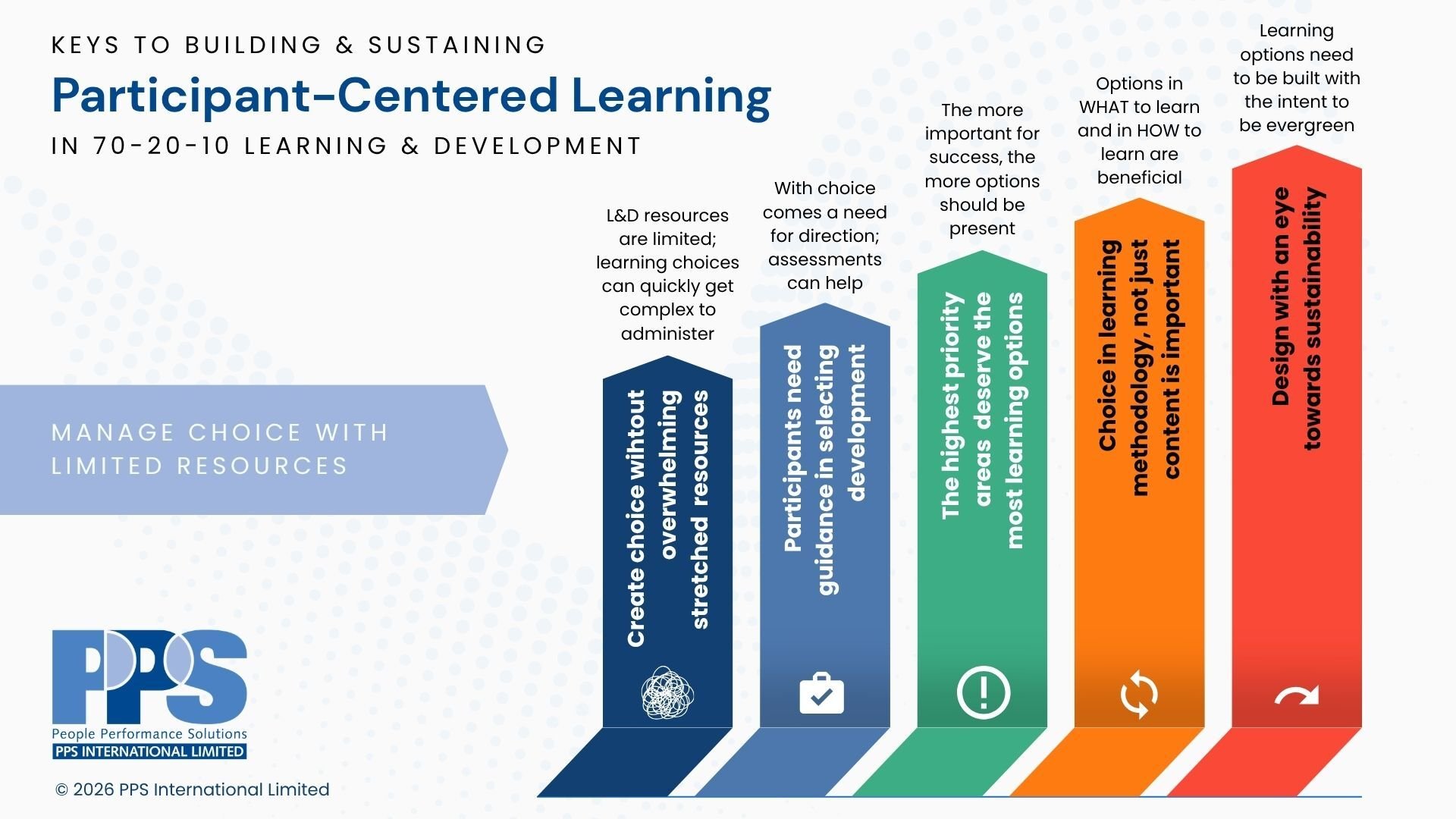
If you or your organization are building participant-centered learning using a 70-20-10 model for learning, a campus-style learning or structuring development paths, consider these keys to success:
- More choice can mean more complexity for those administering and managing development. Keep complexity low where possible.
- Participants faced with choices will still need guidance on what to select and how to sequence their learning. Prepare the learner to use the systems you've set up.
- Not all skills require multiple options for learning. Give priority to those skills that are closely linked to outcomes. These high priority areas benefit from a variety of options for learning.
- Learning choice can be in both WHAT is learned and HOW it is learned. In sorting through options, consider putting the most variety into the methods and leaning into broader content areas.
- Just as having choice can add to complexity in administering and supporting implementation, it also can add to the burden of keeping learning evergreen. Design and build with ease of updating in mind.
Running a 70-20-10 model with limited resources
Talent development teams rarely have the staff to design and administer every option in all three parts of the model. A few practices help a small team keep the model running:
- Curate before you build. Most organizations already have e-learning, reading lists and internal experts that go unused. A learning map that lists the priority skills and links to existing resources costs little to maintain.
- Use the technology people already have. Deliver reminders, short content and peer group agendas through the platforms participants use every day, so that no new system needs to be supported.
- Let managers carry the experience component. A short briefing guide and a few debrief questions help managers assign and debrief the work that makes up most of the model.
- Review the options once a year. Retire links and assignments that are no longer used, which keeps the menu short and current.
How to build a 70-20-10 plan for a program
Here are a few guidelines that help to structure a 70-20-10 plan for a program or a population:
- Start with the priority skills. Identify the few skills most closely linked to outcomes; these are the ones that benefit from options in all three parts of the model.
- Design the formal piece around practice. The higher the difficulty and importance of the skill, the more emphasis on practice with feedback should be built into the learning.
- Give learning from others a format. Mentoring pairs, peer groups and action learning groups work best with an agenda, a cadence and a purpose.
- Turn experience into assignments. A stretch assignment with a finish line, a sponsor and a debrief develops more than one that is simply added to the job.
- Limit the choices. We suggest no more than three development options per need, drawn from more than one part of the model; our guide to writing an individual development plan shows how to document them.
- Brief the manager. Managers who know what the participant is working on can provide the assignments, feedback and conversations that make up most of the model.
- Measure application. Track whether the behaviors are used on the job, not only course completions; our article on measuring whether development worked describes the measures.
Common mistakes
- Treating the percentages as a budget formula. The split is a guideline. Plan the mix around the skill and the role.
- Leaving the 70 to chance. Experience develops people when it is planned, supported and debriefed. Build assignments and debriefs into the plan.
- Running the three parts separately. A workshop with no link to assignments or coaching tends to stay in the classroom. Connect each formal session to an application assignment and a conversation with the manager.
- Offering too many options. A long menu adds complexity for administrators and participants alike. Curate a short list for each priority skill.
- Measuring only the formal learning. Completions show that a course was taken. Ask managers and participants whether the behaviors are being used.
Frequently asked questions
What is the 70-20-10 learning model?
The 70-20-10 learning model is a guideline holding that about 70% of development comes from on-the-job experience, 20% from other people through coaching, mentoring and feedback, and 10% from formal learning such as courses and workshops [2]. It is most useful as a reminder to design all three parts together.
Who developed the 70-20-10 model?
The 70-20-10 model was developed from research on how executives learned on the job, published in the classic book The Lessons of Experience [1]. The percentages were popularized in a development planning guide by Michael Lombardo and Robert Eichinger in 1996 [2].
Is the 70-20-10 model still relevant?
The 70-20-10 model is still relevant as a planning discipline, although the research does not support the exact percentages [3]. Its lasting value is the reminder that most development happens through experience and other people, so a plan made only of courses leaves out most of the learning.
What are examples of the 70-20-10 model?
Examples of the 70-20-10 model include a stretch assignment with a sponsor and a debrief (70), a mentoring pair or peer coaching group (20) and a workshop with practice and feedback (10). The examples above show how the parts fit together for new managers, a global financial services program, sales leaders and a single coaching skill.
How do you use 70-20-10 in an individual development plan?
Using 70-20-10 in an individual development plan means choosing at least one experience-based option, one that involves other people and, where it fits, one formal option for each development need. Each option is attached to a real situation and a date.
How many development options should a participant have?
A participant should have no more than three development options per need. Plans with more than three tend to lose focus, and a short list is easier for participants and administrators to manage.
Where to start
Pick one program and list what participants do before, during and after the formal sessions. If most of the plan sits in the formal sessions, add one assignment and one structure for learning from others for each priority skill, then brief the managers.
Contact us if you want help designing the assignments, peer learning and manager support that surround your formal programs.
Start a conversation about your 70-20-10 learning plan
References
- McCall, M. W., Lombardo, M. M. and Morrison, A. M. (1988). The Lessons of Experience: How Successful Executives Develop on the Job. Lexington Books.
- Lombardo, M. M. and Eichinger, R. W. (1996). The Career Architect Development Planner. Lominger.
- Clardy, A. (2018). 70-20-10 and the dominance of informal learning: A fact in search of evidence. Human Resource Development Review, 17(2), 153-178. https://doi.org/10.1177/1534484318759399
- Johnson, S. J., Blackman, D. A. and Buick, F. (2018). The 70:20:10 framework and the transfer of learning. Human Resource Development Quarterly, 29(4), 383-402. https://doi.org/10.1002/hrdq.21330