An AI adoption strategy is the plan for getting people across an organization to use AI tools well, not the plan for buying them. Organizations rank successful AI adoption in their top priorities for the coming year, and because of their reach within the organization, leaders play the key role in whether it happens. While many leaders are being told to adopt and integrate AI into their work, most of their teams are not ready, and some are resistant. This sets up a question for leaders who want to drive AI adoption: what to do? This article covers why adoption stalls, the five things leaders do that move the needle, the practical ways we see leaders support AI adoption, an AI change management sequence for talent development professionals and how to measure whether adoption is happening. We partner with clients on AI adoption through our change and transition practice, because adoption is a change initiative before it is a technology rollout.
Why AI adoption stalls, and why it is rarely the technology
Resistance to AI is rarely about the technology itself. It is often about uncertainty. People want to know what it means for their role now and into the future. They may be concerned about AI diminishing their value to the organization. Others are willing to adopt AI in theory, yet resistant because of the inevitable drag that occurs on productivity when making a change to a well-working process.
The research matches what we see. Gallup's 2025 workplace study found that frequent AI use at work nearly doubled in two years, from 11% to 19% of U.S. employees, while only 22% said their organization had communicated a clear plan for integrating AI; employees who had heard a clear plan were three times as likely to feel very prepared to work with AI [1]. Leaders are ahead of their teams: 33% of managers of managers use AI a few times a week or more, compared with 16% of individual contributors and 9% of front-line and production workers [1].
Employees who had heard a clear plan for integrating AI were three times as likely to feel very prepared to work with it. Gallup, 2025 [1].
Those three concerns, the role, the value and the drag on productivity, are the ones we hear most in workshops. These issues are answered by a leader who can describe AI's benefits to the team and individuals and how work will change. It also helps for the leader to understand and support people while they learn. Keep in mind that the concerns are reasonable. A team that has spent years refining a process often does expect that a new tool will slow that process down before it speeds it up. Leaders who acknowledge this openly are more credible than those who promise no adjustment period at all.
An AI adoption framework for leaders
Through our work with thousands of leaders around the globe, we know that effective leaders do not force adoption. They guide by creating clarity, modeling value and increasing confidence. When leaders ask us how to improve AI adoption on their teams, we start with five things a leader can do:
| What Leaders Do | What It Looks Like | How It Supports Adoption for the Team |
|---|---|---|
| Create clarity | Say what AI is for in this team and what it is not for, which tools are sanctioned and how roles are expected to change over the next year. | Uncertainty about the role and the future goes down, which is often a primary source of resistance. |
| Model using AI tools | Use the tools visibly in real work, share what worked and what did not and learn alongside the team. It's okay to be advanced, but slow down enough to bring others along. | Permission to try. People do what they see their leader do far more than what they are told. |
| Make it relevant | Connect AI use to the team's actual projects: drafting, synthesizing, preparing analyses, summarizing customer input. | Adoption becomes tangible, and for many people interesting, because the use case is theirs. |
| Build confidence | Assign learning, pair people to experiment together and make it safe to produce a poor first few results. | Experimentation, which is critical for adoption, stops learning from feeling risky. |
| Set expectations and reinforce | Consider and discuss AI use at the start of assignments, discuss it in one-on-ones and team meetings and recognize good examples. | Use becomes normal rather than optional, and the early adopters encourage others. |
Practical ways leaders can support AI adoption
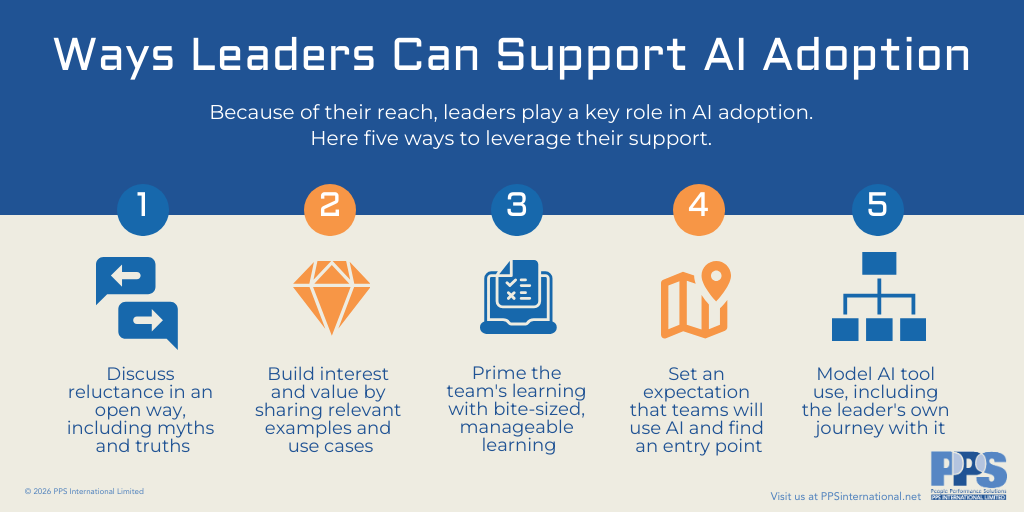
Practically speaking, effective leaders:
- Discuss reluctance in an open way. A good way to introduce and open discussions is to share your own initial concerns. Bring up myths and truths about AI. For example, AI supports automation of routine tasks and can diminish rote work. Using AI tools as thinking partners can strengthen individuals' capabilities by sparking creativity and expanding on a partially formed idea, or improving analysis to streamline decision making by summarizing large sets of data. Most professional work includes judgment, stakeholder management and ethical tradeoffs, and those remain human-centered activities.
- Build interest through relevance. Leaders who support AI adoption connect AI use directly to real projects and work. To make these connections, leaders can share use cases, for example drafting communications, synthesizing information or preparing analyses using their team's work. When people see how to use AI tools in their own work, adoption becomes tangible and even exciting.
- Prime the team's learning. If your teams have limited use of AI tools, they may lack the confidence to experiment, which is essential to learning and adoption. A way to boost confidence is for leaders to give learning assignments: watch a video on an available tool, partner with a peer to 'play' with the technology, or attend a formal training session and report back.
- Set an expectation that teams will use AI. At the start of projects and assignments, leaders can give direction that individuals should experiment with AI to augment their work. Another approach is for leaders to discuss with their teams where the teams might use available AI tools. Using these and other ideas, adoption accelerates when leaders normalize usage.
- Agree how the team will use AI. A short conversation about which tasks are fair game, which need a human check, what data may not go into a tool and how the team will share what it learns removes the guesswork that keeps cautious people on the sidelines.
- Make the learning visible. A standing five minutes in the team meeting for 'what I tried this week' spreads use cases faster than any communication campaign, and it lets the leader recognize effort rather than only results.
Modeling using AI tools is most important
Above all, leaders will most support AI adoption by modeling its use. Contrary to perceptions, leaders do not need to be experts in using AI tools in order to be strong role models for its use. In fact, it can be very powerful for leaders to learn alongside their teams. Because of this dynamic, leaders and teams can effectively attend training to support AI adoption side by side. Often, training and development professionals are concerned about putting leaders and their direct reports through training together. But, unlike other programs, such as giving feedback or handling conflict, the leader and direct report dynamic is less pronounced when learning about all things digital, including AI tools. Where possible, we suggest including leaders and their intact teams in learning together so that they can apply what they learn in real time.
AI change management: the sequence we use with clients
Many rollouts skip AI adoption change management. Yet, this is where talent development professionals make a significant difference. Here is the sequence we use with clients to support AI adoption. The stages are drawn from our digital upskilling and generative AI work:
- Establish AI readiness and the business reason. Identify which workflows AI will affect, which tools are sanctioned, what the policy says about data and what the organization expects to gain. Without a stated business reason, adoption efforts showcase tools instead of changing how work gets done.
- Align leaders first. Leaders carry the same three concerns as their teams (the role, the value and the initial drag on productivity) and a fourth unique to them: not wanting to look less expert than the people they lead. A leaders-only session that tackles these concerns and provides a head start easily justifies itself in the cohorts that follow.
- Design a blended learning journey for leaders and their intact teams. In our Gen AI Playground work with a global organization, the journey combined preparatory activities, virtual instructor-led sessions and hands-on experiences in a playground built around the client's own generative AI tools, with outcomes that ranged from crafting effective prompts and evaluating outputs to adhering to company policies and becoming champions within work units.
- Move to application quickly. The playground was followed by 21 days of defined activities to increase adoption in participants' real workflows. Without an application period, training rarely translates into everyday practice.
- Reinforce through the operating rhythm. To keep adoption moving after the program ends, rely on unit champions, standing agenda items in team meetings and managers asking about it in one-on-ones.
- Measure and adjust. You can see where adoption is taking hold through usage data, use cases in production and confidence surveys.
Be realistic about timing. A first wave for a leadership population and their teams usually takes a minimum of 16 weeks from the readiness conversation to the end of the application period, and larger organizations run in cohorts over a year or more. Our digital upskilling program for one global organization reached nearly 2,000 participants that way, through cascading workshops aligned to the client's own digital capability framework.
Upskilling for AI: what the learning journey covers
Many AI adoption strategies go wrong with AI upskilling. The goal in AI adoption is to produce people who can decide when a tool is the right choice and judge its output. The journeys that are effective teach the concepts underneath the tools: what generative AI is and is not good at, how to craft a prompt and iterate on it, how to edit and evaluate an output for accuracy and how to stay inside policy and ethical guidelines. They then let people practice on their own work with the organization's own tools, in a setting where a poor first attempt has low risk. Our Digital Transformation Series is built around that sequence. Additionally, microlearning accessible in the flow of work can be a practical way to reach large or dispersed populations after the live sessions.
Common AI adoption challenges and how leaders handle them
| Challenge | What It Looks Like | What Leaders Do |
|---|---|---|
| Fear of being replaced | Quiet non-use, questions about headcount, resistance framed as quality concerns. | Say plainly what AI will and will not change in roles over the next year, and show the judgment-heavy parts of the work that stay human. |
| Productivity drag as you get started | "It is faster to do it the old way", abandoned pilots. | Acknowledge the drag, protect time for learning and pick first use cases where the gain is obvious right away. |
| Uncertainty about what is allowed | People use unsanctioned tools privately or avoid AI altogether. | Publish the sanctioned tools, the data rules and who to ask, and make the sanctioned path the easiest one to follow. |
| Uneven skills | A limited number of enthusiasts carry the team while the rest watch. | Pair people, run learning assignments and set an expectation that everyone experiments, not only the enthusiasts. |
| No relevant use cases | "I do not see how this applies to my work." | Build the use cases from the team's own tasks, in the team's own words, and share them in the meeting. |
| Leaders who do not use it | Adoption is delegated to a project or to IT. | Use the tools visibly and learn with the team; adoption follows the leader's behavior more than any announcement. |
Measuring AI adoption
Measuring adoption does not need to be complicated, and it is worth deciding what to track before the first session. Here are the indicators we look at with clients:
- Active use of sanctioned tools, such as weekly active users by team, from the tools' own usage reports.
- Activity inside the tools. In one life sciences pilot, prompting activity rose from 9% to 53% of the 300 participants after the program, which is the kind of figure sponsors remember.
- Use cases in production per team, and the number that spread from one team to another.
- Confidence and intent-to-use items on a short pulse survey at 30, 60 and 90 days.
- Time saved, estimated by participants and their managers and reported conservatively.
- Policy or quality incidents, which should stay low as use rises; a rise is a signal to revisit the guidelines and the training.
Our article on training effectiveness measurement covers how to connect indicators like these to business outcomes.
Frequently asked questions
What is an AI adoption strategy?
An AI adoption strategy is a plan for getting people across an organization to use AI tools well in their real work: which workflows and tools come first, what leaders are expected to do, how people will learn, how use will be reinforced and how adoption will be measured. The technology choices are a small part of it; most of the work is clarity, learning and leader behavior.
What role should leadership play in promoting AI adoption within a team?
Leaders play a role in prompting AI adoption when they create clarity about what AI is for and what it is not, model use in their own work, connect the tools to the team's real projects, build confidence through learning assignments and set the expectation that the team will use AI, then reinforce it in one-on-ones and team meetings. Leaders do not need to be the experts; learning alongside the team is often more effective.
What must leaders unlearn to adopt AI effectively?
Three habits come up most to be unlearned before adopting AI: the leader needing to be the expert before introducing something to the team, measuring effort by hours rather than by outcomes, and treating a poor first result as a failure rather than as part of learning a tool. Leaders who can say, "I am learning this, too" and who protect time for experimentation see faster adoption than those who wait until they have mastered the tools.
How do you encourage AI adoption among employees who are resistant?
To encourage those resistant to AI adoption, start by asking what the resistance is about, because it is usually uncertainty about the role, the value of the person's work or the productivity drag of changing a process that works. Answer those directly, pick a first use case from the person's own work where the gain is obvious, pair them with a colleague who is a step ahead and make it safe to produce a poor first result. Forcing use rarely produces skill.
Why do so many AI adoption efforts fail to deliver value?
Many AI adoption efforts fail because most of the effort goes into the technology and most of the value depends on people and process: whether leaders model use, whether people know what is allowed, whether they have time to learn and whether the use cases are theirs. Adoption efforts that treat the rollout as a change initiative, with leaders aligned first and a learning journey built around real work, avoid most of the common failures.
Should leaders and their teams attend AI training together?
In most cases, yes, leaders and teams should attend AI training together. Unlike programs on feedback or conflict, where the leader and direct report dynamic changes the conversation, learning about digital tools together tends to work well, and it gives leaders a natural way to model use without needing to be the expert. Where possible, we suggest including leaders and their intact teams in the same learning journey so that application can start immediately.
How long does AI adoption take?
A first wave for AI adoption by a leadership population and their intact teams usually takes a minimum of 16 weeks from readiness conversation to the end of the application period. Organization-wide adoption runs in cohorts over a year or more, with usage data showing where a second wave of support is needed.
Where to start
Begin with a set of champions such as a segment of the leader population and their teams, agree the business reason and the sanctioned tools and co-create guidelines with those teams, and run the leaders' session before anyone else's. Learn more about our support for AI adoption, including our digital transformation programs and our AI training for employees case study, and see more of our change and transition programs. We can help your organization overcome AI adoption challenges.
Contact us to explore AI adoption support.
Start a conversation about AI adoption
References
- Pendell, R. (2025, June 15). AI Use at Work Has Nearly Doubled in Two Years. Gallup. gallup.com.