Many organizations spend time in quarters three and four of the year establishing financial plans and budgets for leadership training and development activities in the new year, and it is always a good idea to benchmark and compare as a way to check your level of competitiveness in developing talent. The short answer to the cost of leadership training is that it ranges from a few hundred dollars per leader for self-paced and internally delivered options to well over $10,000 per leader for executive programs with assessments and coaching. However, the number that matters more than any average is the one your budget produces for the outcome your sponsors expect. This article gives typical cost ranges by format, what drives the price, the most recent benchmark data on what organizations spend, a way to build a leadership development budget and options for developing talent when the budget is limited. It draws on our leadership development work with organizations large and small.
What leadership training costs: typical ranges by format
Here are the ranges we see in the U.S. market for the common formats, offered for planning rather than as quotes. Prices vary with customization, group size, facilitator sourcing and location:
| Format | Typical Cost | What Is Usually Included | Best For |
|---|---|---|---|
| Open-enrollment leadership course, one to three days | $1,500 to $3,000 per participant for frontline leadership; $4,000 to $9,000 per participant for mid-level managers; $10,000 to $16,000 per participant for senior executives. | Tuition, materials and sometimes an assessment and/or coaching session. Travel and shipping expenses are extra. | One or two leaders at a time, or a benchmark experience for more senior leaders. |
| In-house facilitated workshop, one or two days | $6,000 to $11,000 per workshop day for a group of 10 to 20 employees, which works out to roughly $300 to $600 per participant per day. | Light design tailoring, facilitation manual for an internal trainer, participant materials and workbook licensing (when applicable). | Cohorts of first-line and mid-level leaders where a shared vocabulary matters. |
| Multi-month cohort program | $2,500 to $10,000 per emerging or mid-level leader over three to six months, depending on level and the amount of coaching included. | Assessment(s), four to six training sessions (mix of webinars and in-person workshops), application work between sessions, manager briefings and group or individual coaching. | Building a leadership pipeline or changing how a whole level of the organization leads. |
| Executive coaching | $300 to $600 an hour, or $5,000 to $17,000 for a six-month engagement; higher for senior executives. | An assessment, regular sessions, stakeholder input and a development plan. | Leaders in transition, high-potential executives and situations too specific for a program. |
| Assessments such as 360-degree feedback and style inventories | $150 to $750 per leader, plus debrief time. | The instrument, the report and, ideally, a debrief conversation. | The start of a cohort program or a coaching engagement. |
| Self-paced and microlearning | $20 to $150 per learner per year at scale, plus design if the content is custom. | Licensed or lightly customized modules, often inside an existing platform. | Reinforcement, reaching large or dispersed populations and low-volume roles. |
| Train-the-trainer licensing | Priced per program and per facilitator; often the lowest cost per participant at volume once internal trainers are certified. | Facilitator certification, leader's guides and materials. | Organizations that run many cohorts a year and have credible internal trainers. |
Keep in mind that the largest cost is participant time, which is not always considered in total budgets.
What drives the cost of leadership training
When two proposals for the same audience differ by a factor of three, the difference is almost always in one or more of the following areas:
- Customization. Off-the-shelf content costs less to license but more to make relevant; a program built around your own success profile, cases and language costs more up front but yields relevant skills sooner.
- Level of the audience. First-line leader programs are the most economical per person, as senior and executive programs typically include more assessments, more coaching and more senior facilitators.
- Duration and the number of touchpoints. A single workshop is inexpensive and rarely changes behavior. In contrast, a program with application assignments, follow-up sessions and manager involvement costs more, but is more likely to drive lasting behavioral change.
- Delivery format. Virtual delivery removes travel and venue costs, yet may not be as engaging for all learners. Hybrid trainings add design and production effort that often costs more than running two separate sessions, yet tend to engage learners to a greater degree and enhance the retention of program content as a result.
- Group size. Facilitation is priced per day, so a cohort of 18 costs far less per learner than a cohort of 8. However, it is advised to assign a participant cap based on program format and content, as practice and feedback suffer if the cohort becomes too large.
- Assessments and coaching. Each adds a per-leader cost that is worth paying for where it changes the outcome, such as assigning a 360-degree assessment before a program or coaching for leaders in transition. However, these should not be budgeted into all offerings by default.
- Facilitator sourcing. Internal trainers and managers as trainers lower the delivery cost per session, but there is a hidden cost of rework, rescheduling and coordination when an internal resource is no longer available, especially when their availability changes at the last minute. Because of this, we have rarely seen a project that relied solely on internal adjunct faculty be sustainable over time.
- Reinforcement and measurement. Budgeting for follow-up, manager briefings and a measurement plan adds a small percentage to the program cost, and is the difference between a program that is remembered and one whose impact is measured. Our guide to measuring leadership development covers what to track.
Leadership training budget benchmarks: what organizations spend
Plenty of good data exist to help us understand trends in spending for training activities, and to provide guidance on setting training budgets. Training magazine's 2025 Training Industry Report, based on U.S. organizations with 100 or more employees surveyed between April and July 2025, found total U.S. training expenditures of $102.8 billion, up 4.9% on the prior year, with spending on outside products and services up 29% to $16 billion [1]. Spending per learner averaged $874, up from $774 the year before, and it varied more by company size than by industry; small companies spent $1,091 per learner, midsize companies $782 and large companies $468, while employees received an average of 40 hours of training, down from 47 [1]. Management and supervisory training accounted for about 13% of the average training budget, and outsourced training averaged $217,178 per organization, about 7% of budgets [1].
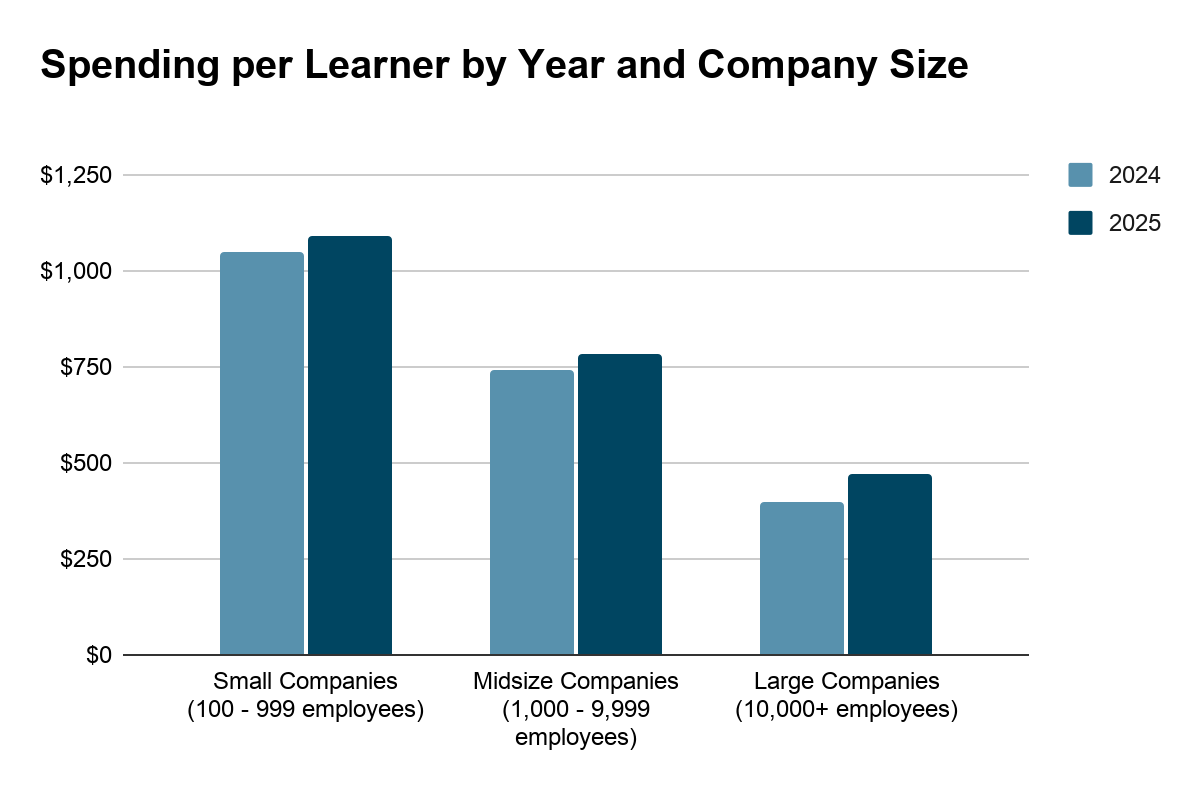
Spending per learner by company size, 2024 and 2025 [1, 4].
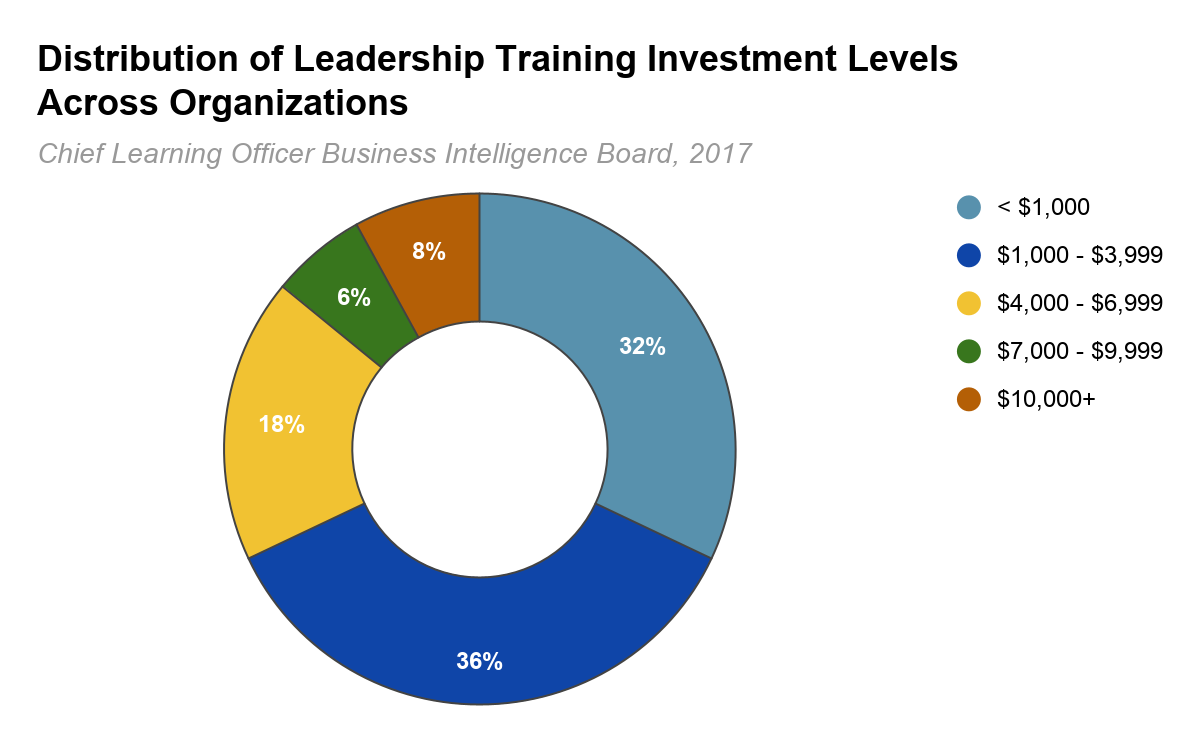
Leadership development on its own is harder to benchmark, because most surveys report training in total. The most recent public distribution of spending per leader that we have seen came from the Chief Learning Officer Business Intelligence Board in 2017, when 94% of learning organizations planned to increase or hold their leadership development investment and the average spend per person broke down as follows [2]:
- Less than $1,000: 32%.
- $1,000 to $3,999: 36%.
- $4,000 to $6,999: 18%.
- $7,000 to $9,999: 6%.
- $10,000 and more: 8%.
Organizations who invest in leadership training cite their top priorities as growing the succession pipeline, retaining high-potential employees and fostering innovation and creative thinking [2]. Those priorities have not changed much in our recent client conversations. However, training formats have moved toward virtual and hybrid deliveries that include a blend of microlearning and learning from experience, and away from multi-day events. How does your level of investment compare, and what programs do you have in place to retain and develop your top talent?
How to build a leadership development budget
Here is the sequence we use with clients, and it starts a long way from a price list:
- Agree on the business reason and two or three outcomes with sponsors. 'Retain first-line leaders through their second year' and 'reduce escalations to the plant manager' size a budget; 'better leaders' does not.
- Evaluate the population by level and decide who goes first. Most budgets cannot develop everyone in one year, and a first cohort chosen for business impact builds the case for the next.
- Choose the learning methodology before choosing vendors. On-the-job experience and learning from others cost time rather than fees, and they should make up the bulk of development; our 20 ways to develop skills and knowledge is the menu we use for this step.
- Price the formal components from the ranges above: workshops, assessments, coaching, materials and any licensing.
- Add assessments and coaching where they change the outcome. A 360-degree assessment before a program and coaching for leaders in transition are usually worth including; coaching for everyone usually is not.
- Budget participant and manager time realistically, including the managers of those in the cohorts who need their own briefing.
- Reserve part of the budget for reinforcement and measurement, such as follow-up sessions, pulse surveys and a manager observation rubric at 90 or 120 days.
- Work in phases. Start with the program kickoff and high-priority skill building with application inside the business cadence; organizations can always add support tools as well as individual and group development in later phases.
- Revisit the budget annually against the measures of success for development, such as KPIs and business outcomes, which is also the moment to refresh an existing program rather than replace it.
As an illustration, here is what a six-month program for a cohort of 25 first-line leaders might look like (without travel and venue costs):
| Line Item | Basis | Illustrative Cost |
|---|---|---|
| 360-degree assessment with debrief | 25 leaders with 60-minute one-on-one debrief each | $24,000 |
| Four, one-day facilitated workshops | 4 days fully loaded (amortized design, external facilitation, other) | $38,000 |
| Participant materials including in-class and follow-up materials | Per cohort of 25 people | $4,500 |
| Manager briefing for the managers of participants | 90-minute session | $3,500 |
| Three group coaching sessions between workshops | 3, 60-minute sessions at $2,800 each | $8,400 |
| Measurement: pulse survey and a 90-day observation rubric | Design and analysis | $5,500 |
| Total | $83,900 |
Developing talent with a limited budget and other constraints
Organizations have a wide range of budgets for developing talent, and they face other talent development challenges alongside the budget:
- A need to scale leadership development without losing quality.
- A desire to implement consistent, effective coaching for leaders across a large population, when one-on-one coaching engagements are cumbersome to manage and costly to implement; group coaching is often the answer.
- Uncertainty about whether leadership training and other development is effective, and therefore difficulty selling the investment to senior leaders.
- Investing in leadership assessments without a clear connection between what the assessment measures and what is important for development.
- Using virtual facilitated learning to avoid direct costs such as travel, but having hybrid groups of participants, which adds complexity to the design and delivery and tends to decrease learner engagement.
Sometimes organizations also struggle against a low learning culture, which can translate into less support for development and less budget. Taking action to create a learning culture often helps. In the meantime, a few approaches stretch a limited budget without lowering the standard:
- Learning-from-experience checklists and assignments, with links to existing resources and tools, for roles where the volume is too low to run a cohort; these work especially well for new managers in their first days in the role.
- Internal trainers and managers as trainers for delivery, with an external backup on the vendor list for short-notice cover.
- Microlearning in the flow of work for reinforcement and reach, using the platforms people already open.
- Group coaching in place of individual engagements for all but the leaders whose situations require one-on-one support.
- Virtual delivery for content that does not depend on being in the room, and in-person time reserved for practice with feedback.
- Fewer, better-chosen capabilities. Too much content, stretched over too much time, with little opportunity to apply within the business cadence creates a shallow program that struggles to get results, and it costs more; three capabilities that drive outcomes are usually enough.
One such example of this occurred when budget cuts required our design team to approach training for one region of a global technology company a bit differently than the standard approach that had been previously used for that program. Our design team identified that the vast majority of the participants were senior leaders, which allowed them to tailor the content in such a way that it reduced the necessary number of facilitation days. This approach lowered total delivery costs enough to stay within the restricted budget, allowing the office to proceed with the initiative without compromising high-impact executive learning.
Is leadership training worth the cost?
The question sponsors ask is rarely whether leadership training has value in general; it is whether this program, for these leaders, at this price, is worth it. Two things help answer it. The first is the cost of the alternative. Comprehensive exit analyses indicate that a large share of voluntary turnover is preventable and directly linked to supervisory behaviors; Gallup's analysis puts the preventable share at 42% [3]. Against the fully loaded cost of replacing even a handful of people, a program that changes how first-line leaders manage pays for itself quickly, and that is before productivity, quality and customer measures are counted. The second is measurement designed into the program from the start, so that the answer at the end of the year is evidence rather than opinion. Our companion article on how to measure leadership development covers the indicators and a measurement plan.
Frequently asked questions
What is the average cost of leadership training?
For a facilitated in-house workshop, roughly $300 to $600 per participant per day before travel. For a multi-month cohort program with assessments and application work, $2,500 to $10,000 per leader depending on level. Open-enrollment courses run $1,500 to $9,000 per participant for one to three days, and $10,000 to $16,000 for senior executives. Executive coaching is priced separately, usually $5,000 to $17,000 for six months.
How much do companies spend on leadership development per leader?
The most recent public distribution we have seen was from a 2017 Chief Learning Officer survey, and showed about a third of organizations spending under $1,000 per person a year, about a third spending $1,000 to $3,999 and the rest spending more, with 8% above $10,000 [2]. Overall training spend in 2025 averaged $874 per learner across U.S. organizations, with management and supervisory training about 13% of the average budget [1].
What is the 70-20-10 rule for leaders?
This is a guideline stating that most development comes from on-the-job experience (about 70%), a smaller share from learning from others such as managers, mentors and coaches (about 20%) and the smallest share from formal training (about 10%). For budgeting, it means the largest part of a leader's development costs time rather than fees, and the formal 10% works best when it is designed to feed the other 90%.
Are leadership courses worth the cost?
Open-enrollment courses are worth it for one or two leaders who need a benchmark experience or a specific skill, and less so as a strategy for developing a whole level of leaders, where the cost per leader is high and nothing connects the learning to the organization's own priorities. For groups, an in-house program with application and measurement usually delivers more per dollar.
How much does leadership coaching cost?
Typically $300 to $600 an hour, or $5,000 to $17,000 for a six-month engagement, with senior executive coaching above that. Group coaching brings the cost per leader down considerably for populations that share similar challenges; our coaching services page describes both.
How do you budget for leadership development?
- Clarify the desired outcomes with sponsors and size the population by level.
- Choose the mix of experience, including both learning from others and formal training.
- Price the formal components, and add assessments and coaching only where they change the outcome.
- Budget the time, including that which is needed for reinforcement and measurement.
A first cohort chosen for business impact makes the case for the budget that follows.
Where to start
Budget seasons are also the moment to revisit existing programs; see our guide to evolving an existing leadership development program. PPS International Limited has decades of real-world experience supporting talent and learning with organizations large and small, and we are glad to help size a budget against the outcomes you need, whether that is a first cohort, a train-the-trainer license or a full learning journey. See our corporate training programs or start a conversation.
References
- Training magazine (2025, November). 2025 Training Industry Report. trainingmag.com.
- Chief Learning Officer (2018, March 21). Follow the Leadership Spending. chieflearningofficer.com.
- Gallup. 42% of Employee Turnover Is Preventable but Often Ignored. gallup.com.
- Training magazine (2024, November). 2024 Training Industry Report. trainingmag.com.