


Leadership Development
Better (or Worse) Than They Think They Are: Helping Employees Have a Realistic View of Their Performance
As leaders, one of the most important ways to develop team members and build performance is giving specific, targeted feedback–either on-the-spot or through more formal means such as performance reviews and coaching sessions. While most leaders know the value in robust feedback, they also are challenged with providing it.
Challenges in Giving Feedback
For instance, leaders with extensive spans of control or who have limited interaction with their direct reports may find giving feedback difficult; they lack concrete examples gathered over day-to-day interactions that would drive home their points. This happens more frequently if teams are interspersed across distance. Other times, leaders are managing their own steady-stream of projects and work, which presents a challenge to fit planning and giving feedback into already-packed schedules. Yet, there are those supervisors and managers who overcome these challenges only to be faced with another situation that can be difficult to navigate: employees who think their performance is better (or worse) than it truly is. This mismatch can stop managers in their tracks and create awkward, less-than-successful feedback discussions that miss the mark. We work under two feedback premises: (1) that feedback is information that describes an individual’s performance in relationship to a particular standard, and (2) that feedback’s intent is to reinforce or alter behavior—and therefore affects organizational results. If we view feedback from this perspective, ending up with a mismatch in what leaders and employees perceive as current performance is a significant stumbling block. After all, if employees disagree with your assessment of their performance, how encouraged do they feel to change? For sure the challenge is greatest when it presents itself as employees who think their performance is better than their managers do. But, opposite situations aren’t ideal either. The employee who never thinks he or she is doing well can end up focusing on areas that aren’t the highest return on effort of development. (Sometimes good is good enough.)
Dealing with Employees Who Don't Agree with Your Feedback
For those leaders who find themselves with plenty of data and specifics to illustrate their meanings, yet are faced with employees who simply don’t see their performance the same way as themselves, here are some ways to encourage self-analysis:
- Tip off your employees to get and stay organized and up-to-date on their performance. Remind them to keep track of progress, ongoing notes, assessment results and other points of feedback so that they can review them prior to feedback conversations, both formal and informal. Encourage them to ask for feedback from sources other than just you including customers, internal partners and peers.
- For formal feedback situations such as performance reviews, ask employees to schedule specific time to reflect on their own performance before any conversations occur. Even 15 minutes is enough time to consider strengths and development areas. Encourage this time by providing coverage for employees whose roles don’t allow for flexibility in scheduling (for instance, for call center representatives, cover their lines).
- Point out that you expect and encourage them to find at least two things they are doing well (and should maintain) and at least one thing they see as needing upgrade or enhancement. Ask employees to think through any actions they can take to maintain or improve overall results. A simple tool to support this is to prompt with questions such as, “What did you plan to accomplish and how much or little did you do to accomplish these goals?” Or, “What areas of responsibility do you readily take on? Find challenging?”
Questions to Help Employees Analyze Their Performance
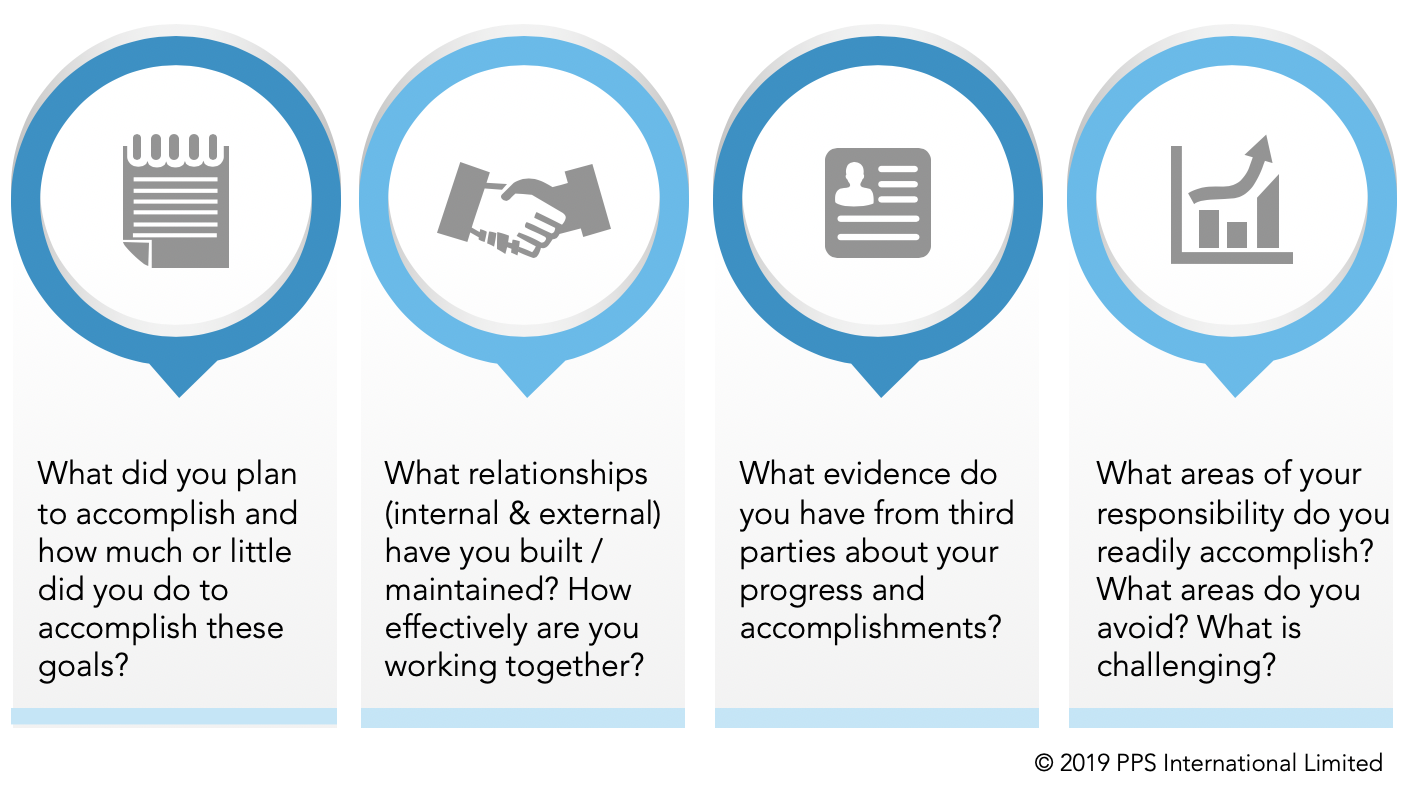
- As part of your preparation for giving feedback, share a simple discussion agenda and ask employees to make their own notes for the conversation.
- When giving feedback, let them go first in the discussion. Set the expectation that during the discussion you want to hear from your employees first about what is working and what isn’t before you add to or reinforce their findings. This will allow you to better know where misalignment is before you share your feedback. It also sets the tone that the employee is responsible for his or her feedback.
Even using these strategies, it’s possible that managers and direct reports will still be misaligned, and in that case, be frank:
- If misalignment comes up, don’t shy away from it. Disclose, “We don’t see things the same way on this point. I think it’s important for us to better understand this gap. How about you tell me what your thinking is and then I’ll share mine.” Then, listen and summarize their points before launching into your own. In most cases, you want to be brief on what is different, starting with the standard you would expect. For example, “The goal is for you to be able to manage your own task list and follow up on open action items without prompting from me or others. What I notice is that on the past two projects, you didn’t follow up with vendors until I asked you to do that as part of our touchbase meeting. This leaves me with responsibility for your tasks and ultimately delays your progress on completion.” Frankness and clarity are helpful to alignment.
In the end, when giving feedback you may not create alignment on perceptions, but these approaches improve the possibility for understanding and ultimately, change in performance. They also encourage a spirit of self-awareness in employees. And, self-awareness is critical to any development.
Start a conversation about supporting managers in giving feedback
Recent Posts
Filter






We’re ready for you.
We enjoy discussing possibilities and approaches, so please reach out! Contact PPS International Limited today to explore how we can support your talent development initiatives.

PPS International Limited is a trusted learning and development partner empowering teams of all sizes with leadership, communication, influence, sales and professional skills training that drives meaningful business results.
© 2026 PPS International Limited. All Rights Reserved